










A technical guide to fiber-reinforced concrete mix design, explaining fiber dosage, geometry, workability, dispersion, batching and performance testing for PP, PAN and PET fibers.
BLOG
A technical guide to fiber-reinforced concrete mix design, explaining fiber dosage, geometry, workability, dispersion, batching and performance testing for PP, PAN and PET fibers.
There is no single cement:sand:aggregate:fiber ratio that works for every fiber-reinforced concrete (FRC) mix. Fiber is a discrete reinforcement component, and its effect depends on fiber geometry, material, dosage, dispersion, the paste available to coat it, aggregate grading, admixture compatibility and the performance required after cracking.
A mix that is easy to place but produces poor fiber distribution may not deliver the specified reinforcement. Conversely, increasing fiber dosage without adjusting the mixture can cause an apparent slump loss, fiber balling or finishing difficulties. A sound fiber-reinforced concrete mix design therefore has to balance fresh-concrete behavior with the hardened performance that the project actually needs.
This guide explains how to establish a practical mix-design process, select a suitable TenaBrix fiber family, control workability and dispersion, and verify performance through testing. For dosage calculations and indicative application ranges, see our concrete fiber reinforcement dosage guide.
In conventional concrete proportioning, the mix ratio describes the relative quantities of cementitious materials, water, fine aggregate and coarse aggregate. In FRC, the base concrete proportions still need to satisfy the specified strength, durability, workability and exposure requirements. Fiber is then introduced as an additional reinforcement parameter, usually specified by mass per unit volume (kg/m³) or by volume fraction.
That distinction matters: a fiber dosage is not a replacement for the water-cementitious materials ratio, nor does it create a universal recipe such as “one part fiber to a fixed number of parts cement.” The correct dosage and mixture adjustments must be established for the selected fiber, concrete constituents, mixing equipment and design objective.
Mass dosage is convenient for batching, but two fibers added at the same kg/m³ may not provide the same reinforcement. Their density, filament diameter, length, cross-section, profile and number of individual filaments can differ. For technical comparison, the fiber volume fraction can be calculated as:
Fiber volume fraction (%) = [Fiber dosage (kg/m³) ÷ Fiber density (kg/m³)] × 100
For a hybrid system, calculate the volume contribution of each fiber separately and then add the contributions. Use the density stated in the relevant product technical data sheet; do not assume that different polymer fibers have identical density or geometry.
Fiber selection should begin with the cracking mechanism or performance requirement—not with a dosage copied from another project. The first question is whether the mix needs early-age crack control, post-crack load transfer, or a combination of functions.
| Project requirement | What the mix design should evaluate | Relevant fiber options |
|---|---|---|
| Plastic-shrinkage and early-age microcrack control | Fine-fiber dispersion, paste coating, finishing behavior and the timing of evaporation / curing | Polypropylene synthetic microfiber; polypropylene fibrillated fiber; selected PET or PAN microfiber grades |
| Post-crack toughness and residual flexural performance | Fiber-matrix interaction, geometry, dosage, orientation and residual strength under the specified test method | Polypropylene synthetic macrofiber; twisted macro-synthetic fiber |
| Combined early-age and post-crack requirements | Compatibility of the two fiber populations, total fiber volume, workability and whether each component contributes a defined function | A project-designed hybrid system, such as PP microfiber with a qualified macro-synthetic fiber |
Microfibers and macrofibers should not be treated as interchangeable. Fine synthetic microfibers are commonly selected for distributed early-age crack control. Macro-synthetic fibers are selected when the design requires a measurable contribution after cracking. A specification that requires residual flexural performance must be supported by appropriate test results—not inferred from tensile strength or from the fiber name alone.
Fiber geometry affects how the material disperses in fresh concrete and how it interacts with the cementitious matrix after hardening. The following distinctions are useful when screening TenaBrix products for a trial mix.
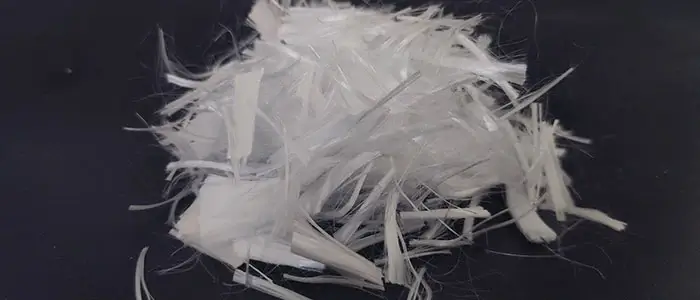
Fine monofilament PP microfiber is intended for distributed micro-reinforcement in concrete, mortar and other cement-based materials. Its fine filament structure makes dispersion and paste coating important mix-design considerations. It is a relevant option when the main objective is to help control plastic-shrinkage cracking and early-age microcracks. See TenaBrix polypropylene synthetic microfiber.
Fibrillated PP fiber has an interconnected mesh-like structure rather than a simple single-filament profile. The structure increases contact with the cement paste and forms a distributed reinforcement network when properly dispersed. TenaBrix lists 6 mm, 19 mm and 38 mm lengths; the suitable length should be selected against the application, aggregate grading and mix design. See fibra di polipropilene fibrillata.
These are both PP macrofiber options, but their surface profiles are different. The embossed profile is designed to promote mechanical interaction with the cement matrix. The curved or wave-shaped profile uses its geometry to create mechanical interlocking. In either case, the mix should be assessed for fiber distribution and post-crack performance at the proposed dosage. Review the embossed type e curved type specifications separately.
The twisted bundle configuration creates mechanical interaction with the surrounding concrete. TenaBrix offers gray and white options; color alone should not be used as a performance criterion. Selection should be based on the technical specification, fiber geometry, dosage, concrete mix and project test results. See TenaBrix twisted macro-synthetic fiber.
Polyacrylonitrile (PAN) fiber and polyester (PET) fiber are separate synthetic fiber families with their own product specifications. PAN fiber is made from polyacrylonitrile, while TenaBrix PET fiber is available in high-tensile-strength and normal-tensile-strength grades. Their suitability should be evaluated using the relevant TDS, required fiber dimensions, mix compatibility and trial results. Do not transfer a dosage or performance assumption from PP fiber to PAN or PET without verification. Read more about Fibra PAN e PET fiber.

Adding fibers changes the fresh mixture. Fibers increase the total surface area that must be coated by cement paste and can make the mix appear less workable or more cohesive. The magnitude of the effect depends on fiber type, geometry, volume and dosage, as well as the original concrete mixture.
An apparent slump reduction does not automatically mean that the water content should be increased. Adding water can change the water-cementitious materials ratio and compromise the specified concrete properties. The American Concrete Institute notes that water-reducing admixtures may help maintain the required slump without changing the w/cm ratio; at higher fiber contents, a mix may also need sufficient paste volume to coat and disperse the fibers. Any adjustment should be confirmed by trial batching.
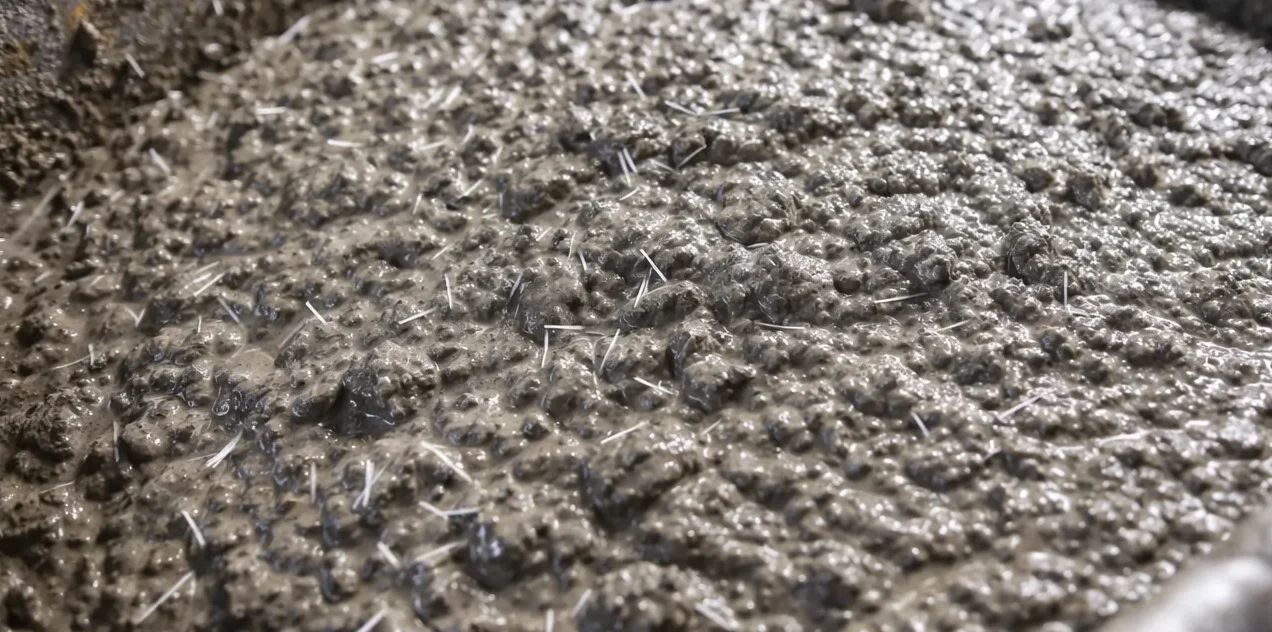
Uniform distribution is essential. Fiber clumps or “balls” create local areas with too much fiber and other areas with too little. They can also interfere with pumping, surface finishing and the consistency of test specimens.
ACI’s practical guidance is available in its notes on mixing fibers into concrete e the effect of fibers on workability. If you would like advice regarding product selection or practical application, please feel free to contact our team.
A successful FRC mix must satisfy both production requirements and the hardened performance criteria in the project specification. A single slump result cannot demonstrate post-crack capacity, and a flexural test result cannot confirm that the concrete can be batched and placed reliably at the job site.
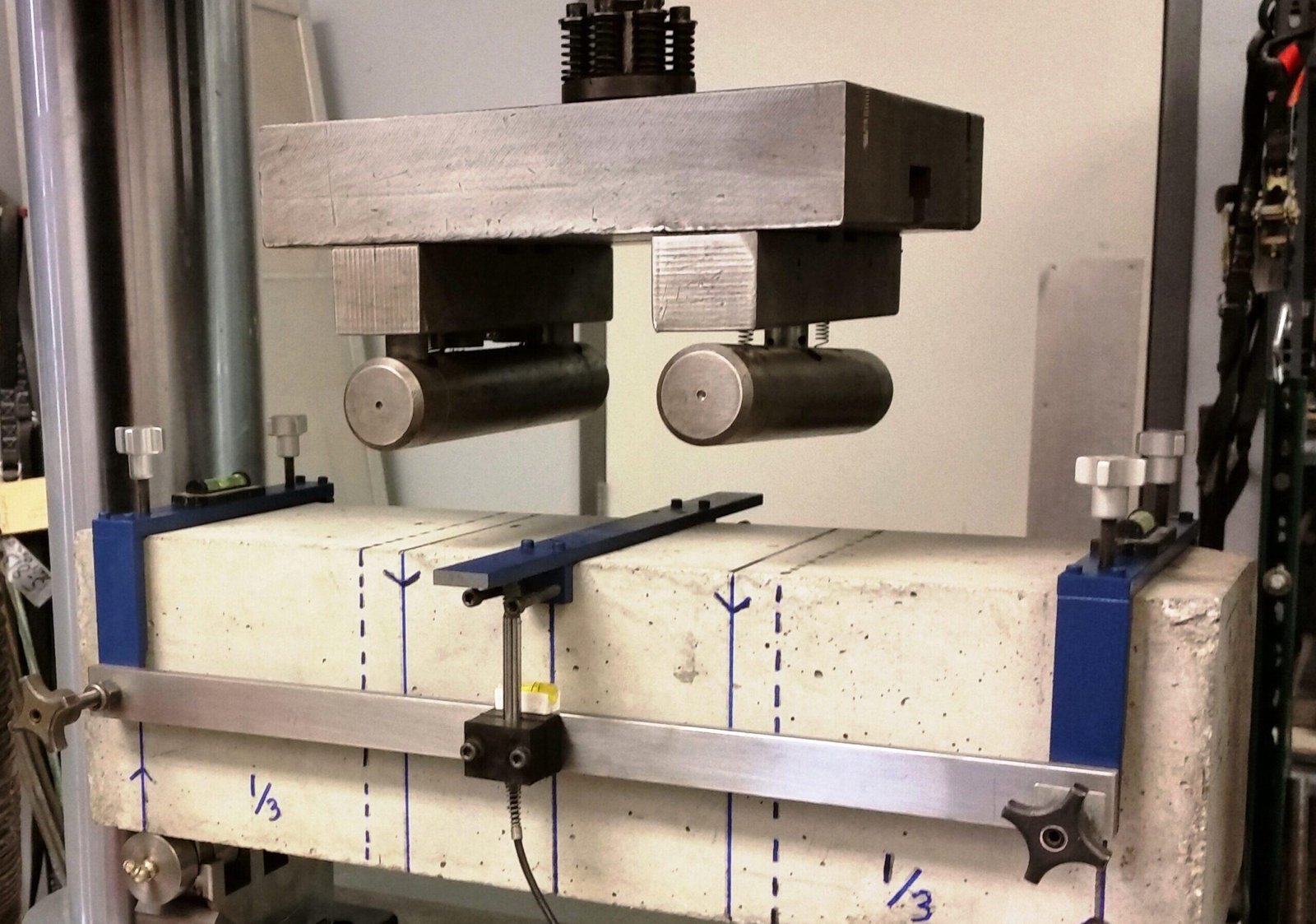
Where macro-synthetic fibers are expected to contribute to post-crack behavior, specify the relevant performance measure and test method before selecting the dosage. ASTM C1609/C1609M evaluates the flexural performance of fiber-reinforced concrete using a beam under third-point loading. It derives first-peak and residual strengths from the load-deflection response and can also quantify specimen toughness. Residual strength at specified deflections is more informative for post-crack performance than a single compressive-strength result.
ASTM C1116/C1116M is a specification for fiber-reinforced concrete, not a substitute for a project-specific performance test. It addresses FRC supplied with its ingredients uniformly mixed. The applicable edition, sampling plan, specimen geometry, curing, test age and acceptance criteria should be stated in the project documents.
For reference, consult the official pages for ASTM C1116/C1116M-23 e ASTM C1609/C1609M-24. Test results are influenced by specimen dimensions, fiber orientation and the test setup; compare results only when the test conditions are comparable.
A reliable fiber-reinforced concrete mix design should be verified through laboratory trials before production. The trial process helps determine whether the selected fiber type, dosage, aggregate grading and admixture system can achieve the required fresh and hardened concrete properties.
| Trial stage | What to vary or verify | What to record |
|---|---|---|
| Baseline mix | Reference concrete without fiber, using the proposed cementitious system and aggregate grading | Proportions, w/cm ratio, slump or flow, air content, unit weight and baseline strength |
| Fiber screening | Compare candidate fiber families or geometries at project-defined trial dosages | Product identification, length/profile, dosage, addition sequence and visible dispersion |
| Workability optimization | Adjust compatible admixture dosage or paste-related proportions where justified; keep the specified w/cm ratio controlled | Fresh properties, mixing time, pumping/placing observations and finishing behavior |
| Performance verification | Test the selected mixture against the specified hardened-concrete criteria | Load-deflection response, residual strengths, toughness or other project-required results |
| Production validation | Confirm the approved mix using the actual plant, mixer, batch size and fiber-feeding method | Batch records, consistency between batches, quality-control results and any corrective actions |
For a fair comparison, change one major variable at a time where practical. If fiber type, dosage, water content and admixture dosage all change together, it becomes difficult to identify why performance improved or deteriorated. Once a mixture is selected, document the approved fiber product, dosage, batching sequence, mixing time, fresh-concrete limits and acceptance tests in the production mix specification.
| Observed problem | Possible mix-design cause | What to investigate |
|---|---|---|
| Fiber balls or clumps | Rapid fiber addition, insufficient mixing, unsuitable sequence or a mix with inadequate coating paste | Fiber feed rate, addition point, mixing time, batch size and paste availability |
| Apparent slump loss | Higher fiber surface area, dosage or cohesion; interaction with aggregate grading and paste volume | Measure slump/flow consistently; evaluate compatible water reducers rather than adding uncontrolled water |
| Uneven surface finish | Fiber length/profile, dosage, finishing method or fiber distribution not suited to the application | Trial the actual finishing process and verify fiber type and dosage against the surface requirement |
| Low or inconsistent residual strength | Fiber dosage or geometry not matched to the design, poor dispersion, orientation effects or inconsistent specimen preparation | Review the load-deflection data, specimen preparation, mixing records and fiber specification |
| Good laboratory results but poor site performance | Plant mixer, batch size, delivery time or placement process differs from the laboratory trial | Run a production-scale validation with the actual batching and delivery equipment |
There is no universal fiber-reinforced concrete mix ratio. The base concrete proportions are designed for the project, while fiber type and dosage are selected according to the required crack-control or post-crack performance. The final combination should be verified through trial batching and testing.
Fiber-reinforced concrete mix design depends on several factors, including fiber material, geometry, dosage, aggregate grading, paste volume, water-cementitious materials ratio and admixture compatibility. The required performance after cracking and the intended placement method should also be considered. Trial batching and testing are essential for confirming the final mixture.
Not automatically. Fibers can cause an apparent slump reduction and make the mix more cohesive, but adding water may change the specified water-cementitious materials ratio. Evaluate aggregate grading, paste volume and compatible water-reducing admixtures before changing the water content.
A hybrid system can be considered when the project has separate early-age crack-control and post-crack performance requirements. The two fiber types should have defined roles, and the combined system must be checked for total volume, dispersion, workability and hardened performance.
Do not infer structural performance from fiber tensile strength or dosage alone. Define the required residual flexural criteria and test the actual concrete mixture using the method specified for the project, such as ASTM C1609/C1609M where applicable.
The starting point is the performance target and the mix’s production method. PP microfiber and fibrillated fiber are options for distributed fine-fiber reinforcement; PP macrofiber and twisted macro-synthetic fiber should be evaluated where post-crack behavior is required. PAN and PET are separate material options and should be assessed using their own technical data. TenaBrix can help review the fiber specification and the project mix requirements before a trial is finalized.
Fiber selection is only one part of a reliable FRC mix. A well-developed fiber-reinforced concrete mix design should balance material selection, fresh-concrete workability, fiber dispersion and verified hardened performance. Share your application, concrete mix information and target performance criteria with the TenaBrix team to identify a suitable fiber for laboratory evaluation.