









Discover how polypropylene synthetic macrofiber reinforces concrete through crack bridging and residual strength. Learn key performance factors, applications, testing methods, and selection tips.
BLOGS
How Polypropylene Synthetic Macrofiber Reinforces Concrete: Crack Bridging, Residual Strength & Applications
|
How Polypropylene Synthetic Macrofiber Reinforces Concrete: Crack Bridging, Residual Strength & Applications
Concrete is strong in compression but relatively weak in tension. When tensile stresses develop because of loading, shrinkage, temperature changes, or restraint, cracks can form and affect the serviceability and durability of concrete structures.
Polypropylene synthetic macrofiber is a fiber reinforcement material designed to improve the behavior of concrete after cracking. Once distributed throughout the concrete matrix, these fibers can bridge cracks, transfer stress across cracked sections, and contribute to residual load-carrying capacity.
Compared with conventional steel reinforcement, polypropylene macrofibers are non-metallic and do not corrode. Depending on the fiber design, concrete mixture, dosage, and engineering requirements, they can be used in applications such as industrial flooring, shotcrete, pavements, and precast concrete.
However, not all synthetic fibers perform the same function, and adding fibers does not automatically make concrete suitable for every structural application. Understanding the reinforcement mechanism, fiber properties, and concrete-level test results is essential when selecting a product.
This guide explains how PP macrofiber reinforces concrete, what affects its performance, how to evaluate relevant test data, and what buyers and engineers should consider before specifying a product.
What Is Polypropylene Synthetic Macrofiber?
Polypropylene synthetic macrofiber is a polymer-based fiber made from polypropylene (PP) and designed for use in concrete reinforcement. It is incorporated into the concrete mixture during batching to provide distributed reinforcement throughout the material.
The term macrofiber generally distinguishes larger synthetic fibers from micro synthetic fibers. A commonly referenced technical distinction uses an equivalent fiber diameter of approximately 0.3 mm: macro synthetic fibers are generally above this threshold, while micro synthetic fibers are below it. The exact classification and applicable requirements should be checked against the relevant standard and product specification.
The distinction is important because the two fiber categories often serve different purposes.
Polypropylene synthetic microfiber is commonly used to help control plastic shrinkage cracking in fresh concrete.
Polypropylene synthetic macrofiber is designed to contribute to crack bridging and post-crack performance in hardened concrete.
These functions can overlap, depending on the product and mix design. Therefore, buyers should confirm the intended performance of a specific fiber rather than selecting it by name alone.
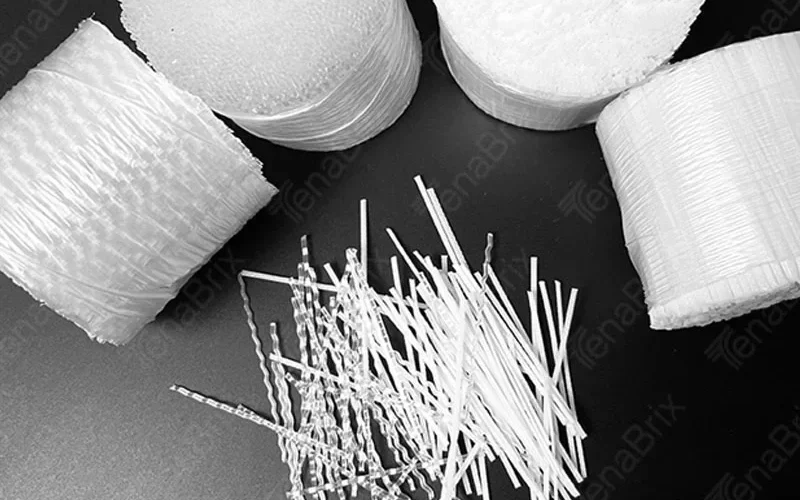
Polypropylene macrofibers are available in different geometries and surface profiles, including embossed, curved, and twisted designs. These features can influence how the fibers disperse, interact with the concrete matrix, and resist pullout as cracks open.
How Does Polypropylene Synthetic Macrofiber Reinforce Concrete?
The main contribution of polypropylene synthetic macrofiber is not that it prevents every crack from forming. Instead, it helps control crack development and can improve the concrete’s response after cracking.
Three related mechanisms help explain its role.
Crack Bridging and Stress Transfer
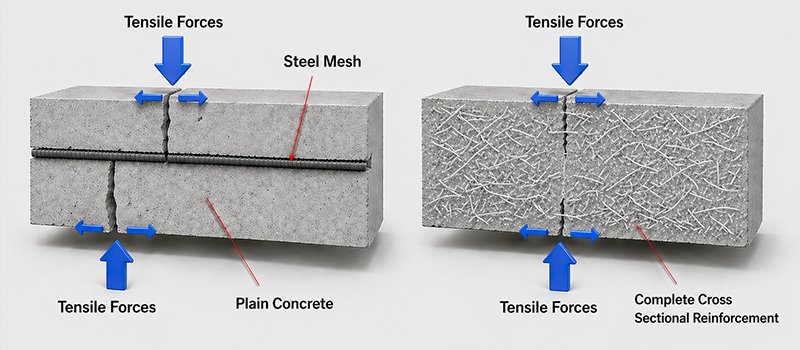
When concrete cracks, fibers crossing the crack can remain connected to both sides of the fractured section. These fibers resist separation and transfer tensile stress across the crack.
This mechanism is known as crack bridging.
As the crack opens, the fibers interact with the surrounding concrete through mechanisms that may include interfacial bonding, friction, mechanical anchorage, and fiber pullout. The effectiveness of this interaction depends on the fiber’s geometry, surface profile, embedment length, and the properties of the concrete matrix.
A suitable fiber design can help limit crack opening and distribute stress across the cracked section. However, the actual response depends on how many fibers cross the crack, their orientation, and their ability to maintain resistance as the crack widens.
Crack bridging does not mean that cracks disappear. It means that fibers can influence how cracks develop and how the material behaves after cracking.
Post-Crack Residual Strength
One of the main reasons for using macro synthetic fibers is their potential contribution to post-crack residual strength.
Residual strength describes the load-carrying response of fiber-reinforced concrete at specified deflections or crack openings after initial cracking. It is different from compressive strength and from the tensile strength of an individual fiber.
When plain concrete cracks, its ability to transfer tensile stress across the cracked section can decrease substantially. Fibers crossing that section may continue to provide resistance, allowing the concrete to retain some load-carrying capacity.
The amount of residual strength developed depends on multiple factors, including:
- Fiber type, length, and geometry
- Fiber dosage and distribution
- Bond and pullout behavior
- Concrete mixture and strength
- The test method and specified deflection or crack opening
This is why fiber tensile strength alone is not enough to predict the performance of a fiber-reinforced concrete slab or other structure. Engineers need relevant concrete-level performance data and an appropriate design method.
Toughness and Energy Absorption
Concrete toughness describes its ability to absorb energy during deformation and cracking. Fibers may contribute to toughness by continuing to bridge cracks while they stretch, debond, or gradually pull out of the concrete matrix.
The resulting behavior depends on the fiber design and the interaction between the fiber and the concrete.
Toughness can be particularly relevant when a project requires the concrete to tolerate deformation or maintain resistance after cracking. However, a higher toughness value in a laboratory specimen does not automatically guarantee better performance in every field application.
Test results should be interpreted in the context of the specimen geometry, loading configuration, concrete mixture, fiber dosage, and intended use.
What Factors Affect Polypropylene Synthetic Macrofiber Performance?
Two products described as PP macrofibers may deliver different results. Their performance depends on more than the polymer used to manufacture them.
Fiber Length and Geometry
Fiber length and geometry influence anchorage, dispersion, and interaction with cracks.
Embossed fibers have a textured surface that may improve mechanical interaction with the cementitious matrix. Curved or twisted designs use their geometry to influence anchorage and pullout behavior. Other designs may prioritize dispersion, pumping, or surface finishing.
No single geometry is automatically best for every application.
When comparing products, review fiber length, cross-sectional dimensions, surface profile, and relevant concrete performance data. Also consider whether the fiber is suitable for the project’s mixing, pumping, placing, and finishing requirements.
Tensile Strength and Elastic Modulus
Tensile strength describes the stress a fiber can withstand before failure under specified test conditions. Elastic modulus describes its stiffness under elastic deformation.
Both properties help characterize a fiber, but they should not be treated as direct substitutes for concrete residual strength.
For example, a fiber with high tensile strength may not deliver the expected post-crack performance if its geometry, bond characteristics, dosage, or interaction with the concrete are unsuitable for the application.
A reliable product comparison should consider individual fiber properties alongside test results from fiber-reinforced concrete.
Dosage, Dispersion, and Mix Design
Fiber dosage affects how many fibers are available to cross potential cracks. However, increasing dosage does not necessarily produce a proportional improvement in performance.
The required dosage depends on the target performance, concrete mixture, fiber design, placing method, and project specifications.
Dispersion also matters. Poor distribution or fiber balling can create inconsistent reinforcement and affect workability. Adding fibers may change the fresh concrete’s handling and finishing characteristics, so the mixture and mixing procedure should be evaluated together.
For commercial or structural applications, establish the dosage through supplier guidance, suitable trial mixes, and project-specific performance requirements rather than relying on a universal dosage figure.
Residual Strength Test Results
For applications where post-crack behavior is important, concrete-level test results provide a more meaningful basis for comparison than fiber specifications alone.
One recognized method is ASTM C1609/C1609M-24, which evaluates the flexural performance of fiber-reinforced concrete using a beam test. It includes first-peak and residual strength measurements and can evaluate specimen toughness.
In Europe, EN 14651 is another commonly referenced test method for determining the flexural tensile strength of metallic fiber-reinforced concrete using a notched beam. For a synthetic fiber product, confirm the suitability of the test method and the applicable project requirements before relying on a reported result.
When requesting technical documentation, check:
- The test method and its version
- The concrete mixture and specimen details
- The fiber dosage and product identification
- The reported residual strength or other relevant performance values
- The testing laboratory and report date, where available
Results should be compared under equivalent or clearly documented conditions. Differences in mixtures, dosages, specimen configurations, and test methods can make direct comparisons misleading.
Applications of PP Macrofiber
PP macrofiber can be used in different concrete applications, but its suitability depends on the performance requirements and engineering design.
Industrial Flooring and Concrete Slabs
Industrial floors in warehouses, factories, and logistics facilities may be exposed to forklift traffic, concentrated loads, abrasion, and repeated service stresses.
Macro synthetic fibers can contribute to crack bridging and post-crack performance in suitable floor systems. Their use should be evaluated alongside slab thickness, loading conditions, joint layout, subgrade support, and specified residual strength.
Depending on the design, fibers may be considered as part of a reinforcement strategy or as an alternative to conventional secondary reinforcement for defined functions. They should not be assumed to replace all reinforcement requirements.
Learn more about TenaBrix’s commercial and industrial slab solutions.
Shotcrete for Tunnels and Underground Construction
Shotcrete is used in tunnel linings, underground excavations, slope stabilization, and other applications where concrete is sprayed onto a surface.
Macro synthetic fibers may improve post-crack performance in appropriately designed shotcrete systems. Selection should consider the required residual performance, spraying process, workability, and project specifications.
For underground support or other safety-critical applications, the fiber-reinforced system must be evaluated against the relevant engineering design and performance requirements.
Roads and Pavements
Concrete roads, pavements, and hardstands experience repeated loading and environmental changes.
PP macrofiber may contribute to crack bridging and post-crack performance in suitable pavement designs. The appropriate product and dosage depend on the pavement structure, traffic loading, concrete mixture, and applicable design criteria.
プレキャストコンクリート
In precast production, fibers may be incorporated into selected components to improve cracking behavior or provide specified post-crack performance.
The suitability of macrofibers depends on component geometry, manufacturing and handling requirements, demolding conditions, and structural design. Trial production and relevant performance testing can help establish whether a particular product meets the intended requirements.
Polypropylene Macrofiber vs. Microfiber vs. Steel Fiber
These reinforcement materials have different typical roles, although their applications may overlap.
| Comparison | Polypropylene Microfiber | Polypropylene Macrofiber | Steel Fiber |
|---|---|---|---|
| Typical role | Early-age plastic shrinkage crack control | Crack bridging and post-crack performance | Crack bridging and post-crack reinforcement |
| 材料 | ポリプロピレン | ポリプロピレン | Steel |
| Corrosion | Non-corrosive | Non-corrosive | Corrosion behavior depends on exposure and conditions |
| Key selection factors | Fiber dimensions, dosage, dispersion, and early-age requirements | Geometry, mechanical properties, dosage, and residual performance | Fiber geometry, mechanical properties, dosage, and exposure conditions |
| Main evaluation | Suitability for early-age crack-control requirements | Relevant post-crack performance and application-specific testing | Relevant post-crack performance and application-specific testing |
These are typical distinctions rather than universal rules. Actual performance depends on the specific product, concrete mixture, dosage, and application.
Microfibers and macrofibers may be used together when a project requires both early-age crack control and post-crack reinforcement. Whether this combination is appropriate should be determined through mix design and performance evaluation.
Steel fibers and macro synthetic fibers may also be alternatives in some applications, but they are not automatically interchangeable. The choice should be based on verified performance and engineering requirements, not material type alone.
Can PP macrofiber Replace Steel Mesh?
Polypropylene synthetic macrofiber may be used as part of a reinforcement strategy in selected applications. In some engineered systems, it may replace conventional secondary reinforcement for specified functions when the design and performance requirements are satisfied.
However, PP macrofiber is not a universal replacement for steel mesh, reinforcing bars, or other structural reinforcement.
The decision depends on the structural role of the existing reinforcement, design loads, crack-width requirements, serviceability criteria, applicable codes, and verified residual performance.
Steel mesh or reinforcing bars may be required for structural capacity, crack control, detailing, or other project-specific functions that cannot be assumed to be satisfied by adding fibers.
Before making a substitution, engineers should review the project specifications, relevant standards, test results, and an appropriate design method. A qualified structural engineer should confirm that the proposed fiber-reinforced system meets all applicable requirements.
For buyers, this means a supplier’s statement that a product can replace steel mesh should be supported by application-relevant documentation rather than treated as a universal guarantee.
How to Choose the Right Polypropylene Synthetic Macrofiber
For concrete producers, contractors, distributors, and project engineers, a practical selection process includes the following steps.
Step 1: Define the application. Identify whether the fiber is intended for industrial flooring, shotcrete, pavements, precast concrete, or another use.
Step 2: Establish performance requirements. Determine whether the project prioritizes crack control, residual strength, toughness, or a combination of properties.
Step 3: Compare technical specifications. Review fiber length, geometry, tensile strength, elastic modulus, and other relevant product parameters.
Step 4: Request relevant test data. Confirm the test method, dosage, concrete mixture, and reported performance values. Check whether the results are relevant to the intended application.
Step 5: Evaluate mixing and placement. Confirm that the proposed dosage and fiber design are compatible with the concrete mix, pumping, placing, and finishing process.
Step 6: Conduct trials where necessary. Validate workability, fiber dispersion, surface finish, and performance before large-scale use.
For bulk procurement, buyers should also assess supplier documentation and consistency. Depending on the project, useful documents may include the technical data sheet (TDS), test reports, product specifications, recommended dosage guidance, packaging details, and quality-control documentation.
To explore TenaBrix products, visit our Polypropylene Synthetic Macrofiber product page.
よくあるご質問
What is polypropylene synthetic macrofiber used for?
Polypropylene synthetic macrofiber is used in selected concrete applications to contribute to crack bridging and post-crack performance. Typical applications include industrial floors, shotcrete, pavements, and precast concrete, subject to project-specific requirements.
How does macrofiber improve concrete after cracking?
Macrofibers that cross a crack can transfer stress between the two sides and resist further separation. This can help the concrete retain residual load-carrying capacity after cracking. The actual improvement depends on the fiber properties, dosage, concrete mixture, and testing conditions.
What is the difference between polypropylene microfiber and macrofiber?
Polypropylene microfiber is commonly used to help control early-age plastic shrinkage cracking. Polypropylene synthetic macrofiber is designed to contribute more substantially to crack bridging and post-crack performance. The intended function of a particular product should be confirmed through its specifications and test data.
Which properties should I compare when buying PP macrofiber?
Compare fiber dimensions, geometry, tensile strength, elastic modulus, recommended dosage, and application guidance. For projects that require post-crack performance, also request relevant concrete test results, including residual strength data where applicable.
Can macro synthetic fibers replace steel fibers?
In some engineered applications, macro synthetic fibers may replace steel fibers for specified functions, such as shrinkage crack control, impact resistance, toughness, or certain slab-on-ground applications. They cannot automatically replace steel fibers in every structure or application. Steel fibers and macro synthetic fibers have different mechanical properties, post-crack performance, fire resistance, and durability. The decision requires appropriate engineering design, testing, and compliance with applicable standards.
How much PP macrofiber should be added to concrete?
There is no single dosage suitable for every application. The required amount depends on the intended performance, concrete mixture, fiber characteristics, construction method, and project specifications. Follow the supplier’s technical guidance and verify the dosage through suitable trials or engineering evaluation.
What documents should I request from a fiber supplier?
Request the TDS, fiber dimensions and geometry, mechanical properties, recommended dosage, application guidance, relevant concrete performance test reports, packaging details, and quality documentation. For projects requiring post-crack performance, prioritize test data relevant to the specified application.
Conclusion
Polypropylene synthetic macrofiber can contribute to concrete reinforcement by bridging cracks, transferring stress across cracked sections, and improving post-crack behavior. Its effectiveness depends on fiber geometry, mechanical properties, dosage, dispersion, and the interaction between the fiber and the concrete matrix.
For engineers and buyers, the most reliable approach is to define the application, compare technical specifications, and evaluate relevant concrete performance test results before selecting a product.
Looking for polypropylene synthetic macrofiber for your concrete project? TenaBrixにお問い合わせください to discuss your application, technical requirements, and product specifications.
Blogs You Might Like

Top 9 Concrete Fibers to Strengthen Your Construct…
Top 9 Concrete Fibers to Strengthen Your Construction Projects

Polyacrylonitrile Fiber in Concrete Benefits Appli…
Polyacrylonitrile (PAN) Fiber in Concrete: Benefits, Applications & Performance


