Choosing a concrete fiber supplier is not simply a matter of comparing price per kilogram. The fiber must match the concrete mix, application, required performance, production process, and delivery schedule. A low-cost product that disperses poorly or cannot provide the test data your project needs may create more risk than savings.
For concrete producers, contractors, dry-mix manufacturers, distributors, and purchasing teams, this guide explains eight practical checks to make before selecting a concrete fiber manufacturer or supplier. It also includes a checklist you can send to potential suppliers to make quotations easier to compare.
1. Check Whether the Supplier Offers the Right Fiber for Your Application
Start with the performance requirement—not the product name. Different fibers perform different functions, and one fiber type should not be treated as a universal replacement for another.
- Polypropylene synthetic microfiber: commonly used to help control plastic shrinkage and early-age cracking in concrete and cement-based mixes.
- Polypropylene synthetic macrofiber: designed to bridge cracks and contribute to post-crack performance in applications such as slabs, industrial floors, and selected precast elements. Structural use must be supported by project-specific testing and design approval.
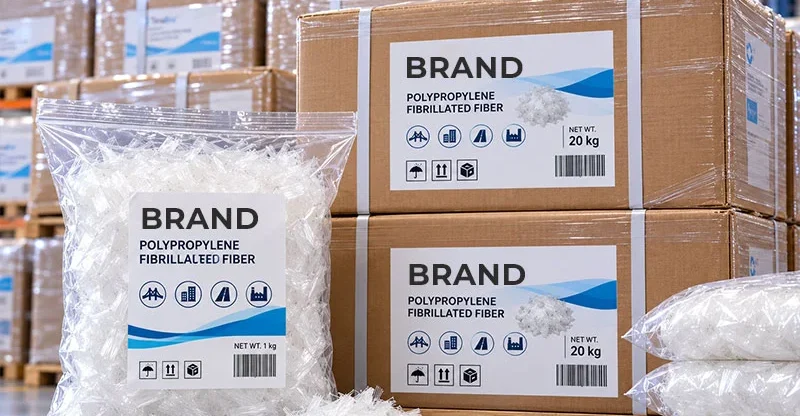
- Fibrillated polypropylene fiber: its network-like structure can support distributed reinforcement and cohesion in suitable concrete and mortar mixes.
- Twisted macro-synthetic fiber: used in selected applications such as shotcrete and concrete structures where crack bridging and residual performance are required.
Ask the concrete fiber supplier to explain which product fits your application and why. For example, a fiber intended for early-age crack control is not automatically suitable as the sole reinforcement for a structural slab.
Explore the TenaBrix concrete fiber product range, including polypropylene microfiber, polypropylene macrofiber, fibrillated polypropylene fiber, e twisted macro-synthetic fiber.
2. Review the Technical Data Sheet and Product Specifications
A reliable concrete fiber supplier should be able to provide clear, current product information. Request the Technical Data Sheet (TDS) and Safety Data Sheet (SDS), then check whether the specifications are relevant to your mix and application.
Depending on the fiber type, useful information may include:
- Polymer or material type and fiber classification
- Fiber length, diameter, and dimensional tolerances
- Tensile strength and elastic modulus, where relevant
- Fiber shape, surface profile, and anchoring design
- Specific gravity and melting point, where applicable
- Recommended dosage range and mixing instructions
- Packaging, storage conditions, and shelf-life information
Do not compare two products using only one specification, such as tensile strength or fiber length. Fiber geometry, dispersion, bond behavior, dosage, concrete composition, and the intended performance all influence the result.
3. Ask for Concrete-Level Test Reports, Not Just Fiber Data
For applications where post-crack performance matters, the performance of the fiber in concrete is more informative than an isolated fiber property. Ask whether the supplier can provide test reports for fiber-reinforced concrete and clarify the mix design, dosage, specimen dimensions, test method, and test results.
Relevant references may include:
- ASTM C1116/C1116M — a specification covering fiber-reinforced concrete.
- ASTM C1609/C1609M — a test method for evaluating the flexural performance of fiber-reinforced concrete, including residual strength at specified deflections.
- BS EN 14889-2 — the European standard for polymer fibers for concrete, covering definitions, specifications, and conformity.
A standards reference does not, by itself, prove that a specific product or project complies. Check the actual report, its scope, the tested product, and whether the results apply to your intended mix and design requirements.
4. Evaluate Manufacturing Consistency and Quality Control
Consistency between batches is essential for concrete producers and distributors. Variations in fiber length, geometry, surface treatment, or packaging can affect dosing, dispersion, workability, and finished concrete performance.
Ask the concrete fiber supplier how it controls raw materials, production parameters, dimensional tolerances, in-process inspection, and finished-product checks. You can also ask whether batch identification and traceability are available for the products you purchase.
Useful questions include:
- Are product specifications controlled against documented tolerances?
- Can the concrete fiber supplier identify the production batch on each package?
- Are inspection or quality records available upon request?
- How are non-conforming products handled?
Look for clear answers and supporting documents rather than relying on general statements such as “high quality” or “strict quality control.”
5. Confirm Experience in Your Specific Application
A supplier may understand fiber production but have limited experience with your concrete application. Ask for relevant application references, technical explanations, or trial data—not simply a list of industries it serves.
For example, the selection criteria for industrial flooring may include residual flexural performance, joint design, finishing requirements, and repeated wheel loads. Shotcrete projects may require attention to pumpability, fiber dispersion, rebound, and the specified sprayed-concrete performance. Precast production may place greater emphasis on cycle time, demoulding, surface finish, and mix compatibility.
Where structural performance is involved, the responsible engineer should determine the design requirements and approve the reinforcement system. A concrete fiber supplier can provide product information and technical support, but should not replace project-specific engineering design.
6. Request Samples and Conduct a Trial with Your Own Mix
Before placing a large order, ask for a representative sample and evaluate it in the actual concrete or mortar mix you intend to use. A laboratory result or demonstration mix may not fully predict performance in your plant, because cement type, aggregate grading, admixtures, mixing equipment, and production conditions can differ.
During a trial, record:
- How easily the fibers are added and dispersed
- Whether fiber balls or visible clumping occur
- Changes in workability, pumping, placing, or finishing
- Fresh and hardened concrete test results relevant to the project
- Whether the proposed dosage and mixing sequence are practical for production
Agree on the trial method and acceptance criteria before testing. For structural or performance-based applications, use the test methods and evaluation criteria specified by the project team.
7. Compare Supply Capacity, Packaging, and Customization
A suitable product is only one part of a successful supply arrangement. Buyers should also confirm whether the supplier can support the required order volume, packaging format, delivery schedule, and export documentation.
Discuss these points before approving a concrete fiber supplier:
- Supply capacity: Can the supplier support both initial trial orders and repeat production orders?
- Packaging: Are the available package weights and formats compatible with your warehouse, batching system, and handling process?
- Personalização: Can fiber length, color, or packaging be adjusted when technically feasible and agreed in advance?
- Lead time: What are the production and shipping lead times, and how are delays communicated?
- Export support: Can the supplier provide the commercial and shipping documents required for your destination market?
For distributors and international buyers, also clarify order quantities, sample arrangements, payment terms, shipping responsibilities, and the process for handling quality claims.
8. Compare Total Project Value, Not Only the Unit Price
The lowest price per kilogram does not necessarily deliver the lowest cost per cubic meter of concrete or per square meter of finished construction. Fiber type, dosage, mix adjustments, labor, batching efficiency, finishing, testing, and project performance requirements all affect the overall cost.
When comparing quotations, use the same basis wherever possible:
- Price per kilogram and the proposed dosage per cubic meter
- Estimated fiber cost per cubic meter of concrete
- Packaging and handling requirements
- Freight, duties, and delivery terms
- Technical support, sample testing, and documentation
- Evidence that the proposed solution meets the project’s performance criteria
For a fair comparison, ask each concrete fiber supplier to quote against the same application, dosage assumptions, packaging, and delivery destination. Do not assume that two fibers with different geometries or functions are interchangeable on a kilogram-for-kilogram basis.
Concrete Fiber Supplier Evaluation Checklist
| What to check |
What to request |
| Product suitability |
Recommended fiber type and application rationale |
| Technical documentation |
Current TDS, SDS, specifications, and mixing guidance |
| Performance evidence |
Relevant concrete test reports and test conditions |
| Quality control |
Inspection process, batch identification, and traceability information |
| Application experience |
Relevant project references or application data |
| Trial support |
Samples, trial recommendations, and evaluation criteria |
| Supply capability |
Production capacity, packaging, lead time, and export support |
| Commercial terms |
Comparable quotation, MOQ, delivery terms, and after-sales support |
Why Consider TenaBrix as Your Concrete Fiber Supplier?
Established in 2002, TenaBrix focuses on polypropylene fiber solutions for concrete reinforcement. The company serves concrete producers, dry-mix manufacturers, contractors, distributors, and international traders across more than 40 countries. Its stated annual production capacity is 20,000 metric tons.
TenaBrix offers several polypropylene fiber options for different reinforcement needs, including synthetic microfibers, synthetic macrofibers, fibrillated fibers, and twisted macro-synthetic fibers. The appropriate product should be selected according to your application, mix design, and required performance—not simply by fiber category.
Learn more about TenaBrix and its manufacturing background, or explore the concrete fiber product range.

Perguntas Frequentes
What should I ask a concrete fiber supplier before ordering?
Ask for the TDS and SDS, product specifications, recommended applications and dosage, relevant concrete test reports, sample availability, quality-control information, packaging options, production lead time, and export support. For performance-based projects, confirm that the supplier’s test data matches your required test method and application.
How do I know which concrete fiber is right for my project?
Start with the function required. Microfibers are commonly selected for early-age crack control, while macro-synthetic fibers may be used where crack bridging and post-crack performance are required. The final choice and dosage depend on the concrete mix, project design, test results, and approval by the responsible engineer.
Should I test a sample before buying concrete fibers in bulk?
Yes. A trial using your own mix and production conditions can help verify dispersion, workability, mixing procedure, and the performance criteria relevant to your application. Agree on the test plan and acceptance criteria before the trial.
Can a concrete fiber supplier provide customized products?
Some manufacturers can offer options such as different fiber lengths, colors, or packaging formats, subject to product capability and order requirements. Confirm the available options, minimum order quantity, lead time, and technical suitability directly with the supplier.
Request a Concrete Fiber Recommendation or Sample
Choosing a concrete fiber supplier is easier when the technical requirements are clear. Tell us about your application, concrete or mortar mix, target dosage, required test standards, estimated quantity, and destination country. The TenaBrix team can help you review suitable polypropylene fiber options and discuss samples, technical documents, and supply requirements.
Contact TenaBrix to request product information, a quotation, or a sample.