تُستخدم الألياف الاصطناعية على نطاق واسع في الخرسانة للمساعدة في التحكم في التشقق وتحسين الأداء. ومع ذلك، لا تؤدي جميع ألياف الخرسانة الغرض نفسه. هناك فئتان شائعتان الاستخدام هما ألياف البولي بروبيلين الاصطناعية الدقيقة (الميكرو) وألياف الماكرو.
على الرغم من أن كليهما يمكن أن يساعد في التحكم في التشقق، إلا أنهما يختلفان في الشكل الهندسي وآليات التسليح ومساهمتهما في أداء الخرسانة.
الفرق الرئيسي هو أن ألياف الميكرو تُستخدم بشكل أساسي للتحكم في تشقق الانكماش اللدن في المراحل المبكرة، بينما يمكن لألياف الماكرو المصممة بشكل صحيح توفير قدرة تحمل الأحمال بعد التشقق في الخرسانة المتصلدة. يعتمد أداؤهما الفعلي على خصائص الألياف والجرعة والمزيج الخرساني والتطبيق.
بالنسبة لمنتجي الخرسانة والمقاولين الهندسيين ومشتري الألياف، يساعد فهم هذا التمييز في تجنب اختيار الألياف بناءً على السعر أو المظهر فقط.
يقارن هذا الدليل بين ألياف الماكرو وألياف الميكرو من حيث التحكم في التشقق والأداء والتطبيقات ومعايير الاختيار العملية.

ما الفرق بين ألياف الماكرو وألياف الميكرو؟
ألياف الماكرو وألياف الميكرو كلاهما مواد تسليح اصطناعية، تُصنَّع عادةً من البولي بروبيلين لتطبيقات الخرسانة. تتعلق فروقهما الرئيسية بأبعادهما ووظائفهما المقصودة ومتطلبات الأداء.
| عامل المقارنة |
ألياف الميكرو |
ألياف الماكرو |
| الشكل الهندسي النموذجي |
ألياف دقيقة وقصيرة |
ألياف أطول بمقاطع عرضية أكبر أو ملامح أكثر ضخامة |
| الوظيفة الأساسية |
المساعدة في التحكم في الانكماش اللدن في المراحل المبكرة وتشقق الاستقرار |
المساعدة في التحكم في التشقق وتوفير أداء ما بعد التشقق |
| آلية التسليح الرئيسية |
التحكم الموزع في التشقق من خلال ألياف دقيقة متعددة |
جسر التشققات والالتصاق والاحتكاك والتثبيت الميكانيكي |
| محور الأداء الرئيسي |
تشقق الانكماش اللدن وتطور التشقق في المراحل المبكرة |
مقاومة الانحناء المتبقية والمتانة وسلوك ما بعد التشقق |
| التطبيقات النموذجية |
البلاطات الخرسانية وبلاطات الأرضيات السكنية والمنتجات سابقة الصب وأنظمة الملاط حيث تكون هناك حاجة للتحكم في التشقق في المراحل المبكرة |
الأرضيات الصناعية والبلاطات على الأرض والأرصفة والخرسانة المرشوشة وتطبيقات مختارة سابقة الصب |
| المساهمة الإنشائية |
غير مخصصة بشكل عام لتوفير تسليح إنشائي بعد التشقق |
قد توفر تسليحاً إنشائياً بعد التشقق عند تصميمها والتحقق منها للتطبيق المحدد |
| عوامل الاختيار الرئيسية |
أبعاد الألياف والتشتت والجرعة وأداء التحكم في التشقق في المراحل المبكرة |
الشكل الهندسي للألياف والجرعة والمقاومة المتبقية والمتانة ومتطلبات التصميم الخاصة بالتطبيق |
هذه الفئات هي تمييزات وظيفية وليست تصنيفاً عالمياً based على طول ثابت واحد. تختلف الأبعاد الدقيقة ومعايير التصنيف حسب المنتج والمعيار المعمول به.
نقطة البداية المفيدة هي تحديد مشكلة التشقق التي يجب معالجتها قبل اختيار نوع الألياف.
كيف تتحكم ألياف الميكرو في التشقق في الخرسانة؟
تشققات الانكماش اللدن
يمكن أن يحدث تشقق الانكماش اللدن عندما يتبخر الماء من سطح الخرسانة الطازجة بمعدل أسرع مما يمكن تعويضه بماء النزف. قد تؤدي تغيرات الحجم الناتجة والإجهادات الشدية إلى تشققات قبل أن تتصلد الخرسانة تماماً.
تُوزَّع ألياف البولي بروبيلين الدقيقة في جميع أنحاء الخرسانة الطازجة. عند اختيارها وتشتيتها بشكل صحيح، يمكن أن تساعد في الحد من تطور وانفتاح تشققات الانكماش اللدن.
تعتمد فعاليتها على عدة عوامل:
- طول الألياف وقطرها وعدد الألياف لكل وحدة حجم.
- جرعة الألياف وتشتيتها في جميع أنحاء الخرسانة.
- نسب مزيج الخرسانة وقابلية التشغيل.
- الظروف البيئية، بما في ذلك درجة الحرارة والرياح والرطوبة ومعدل التبخر.
- ممارسات المعالجة وتوقيت عمليات التشطيب.
تكون ألياف الميكرو ذات أهمية خاصة عندما يحتاج المشروع إلى إدارة التشقق في المراحل المبكرة في البلاطات وطبقات الأرضيات والعناصر الخرسانية الأخرى ذات الأسطح المكشوفة.
ومع ذلك، فإن إضافة ألياف الميكرو لا تلغي الحاجة إلى المعالجة السليمة وتصميم المزيج وتخطيط المفاصل وممارسات الصب الجيدة.
لماذا يهم توزيع الألياف
تكون ألياف الميكرو عادةً دقيقة وكثيرة العدد. تعتمد قدرتها على المساعدة في التحكم في التشقق على مدى فعالية توزيعها في جميع أنحاء الخرسانة.
يمكن أن يؤدي التشتت الضعيف إلى إنشاء مناطق موضعية بتغطية ألياف غير كافية. كما أن الجرعة المفرطة أو إجراء الخلط غير المناسب قد يؤثر على قابلية التشغيل.
لهذا السبب، يجب أن يأخذ اختيار الألياف في الاعتبار كلاً من مواصفات المادة وسلوكها في المزيج الخرساني الفعلي.
مهم: Microfibers primarily intended for plastic shrinkage crack control should not automatically be treated as a replacement for conventional reinforcement or as a means of providing structural residual strength. That function requires appropriate performance evidence and engineering verification.
How Do Macrofibers Reinforce Hardened Concrete?
Unlike microfibers primarily used for early-age crack control, macro synthetic fibers can be designed to carry tensile stress across cracks after the concrete has hardened.
Crack Bridging After Cracking
Concrete has limited tensile capacity. Once a crack forms, fibers crossing the crack can transfer stress between the separated concrete faces.
This mechanism, known as fiber bridging, can help the concrete continue carrying load after the initial crack forms.
The extent of this contribution depends on fiber properties, embedment, bond, orientation, dosage, and the characteristics of the concrete matrix.
Anchorage and Pullout Resistance
Macro synthetic fibers use a combination of interfacial bond, friction, surface texture, and fiber geometry to resist pullout.
Depending on the product design, embossed surfaces, curved profiles, or other geometrical features may contribute to mechanical anchorage. As a crack opens, the fibers can resist separation through the interaction between the fiber and surrounding concrete.
However, stronger anchorage does not automatically mean better overall concrete performance. Fiber rupture, pullout behavior, concrete properties, and the load–displacement response all affect the final result.
Residual Flexural Strength and Toughness
For applications that require post-cracking performance, the important question is not simply whether the concrete cracks, but how it behaves after cracking.
Residual flexural strength indicates the load-carrying capacity at specified deflections in an appropriate flexural test. Toughness or energy absorption describes the work sustained over a defined deformation range.
These properties are particularly important when evaluating macro synthetic fibers for industrial floors, pavements, shotcrete, and other applications where post-cracking behavior matters.
A product’s tensile strength or fiber length alone cannot establish its performance in reinforced concrete. Testing of the concrete mixture at the intended dosage is much more informative.
Macro Synthetic Fiber vs. Microfiber: Which Applications Need Each Type?
The best choice depends on the concrete’s cracking risks and the performance requirements of the finished element.
Industrial Floors and Slabs on Ground
Industrial floors may be exposed to wheel loads, equipment loads, shrinkage, and temperature changes.
Microfibers: May be appropriate when the main objective is to reduce plastic shrinkage cracking during the early stages of concrete placement and hardening.
Macro synthetic fibers: May be considered when the design also requires residual flexural strength and post-cracking load-carrying capacity.
For example, a slab may need early-age crack control as well as a defined post-cracking performance. In that case, selecting a macrofiber system may address the latter requirement, while early-age crack control still depends on the concrete mixture, environmental conditions, curing, and construction practices.These two types of fibers can be used in combination.
The choice should follow the slab design, loading conditions, joint layout, and specified performance criteria.
Residential Floor Slabs
For residential floor slabs where the primary concern is plastic shrinkage cracking, polypropylene microfibers may be suitable.
Macro synthetic fibers may be considered when the slab design requires additional post-cracking performance, but they should not be selected simply because they are larger or appear stronger.
The required reinforcement system depends on the slab’s structural function, ground support, loading, thickness, and applicable design provisions.
الأرصفة الخرسانية
Concrete pavements may experience shrinkage, temperature-related movement, traffic loading, and cracking caused by restraint or inadequate support.
Microfibers can help address certain early-age cracking concerns. Macro synthetic fibers may provide post-cracking performance when the fiber-reinforced concrete is designed and tested for that purpose.
Neither fiber type replaces the need for suitable pavement thickness, subgrade preparation, joint design, and curing.
Shotcrete and Tunnel Construction
Macro synthetic fibers are used in selected shotcrete applications where post-cracking performance and energy absorption are important.
Microfibers may serve a different purpose, such as early-age crack control, depending on the formulation and application.
For tunnel support or other engineered shotcrete systems, the fiber selection must satisfy the specified toughness, deformation, and support requirements. The two fiber categories should not be considered interchangeable.
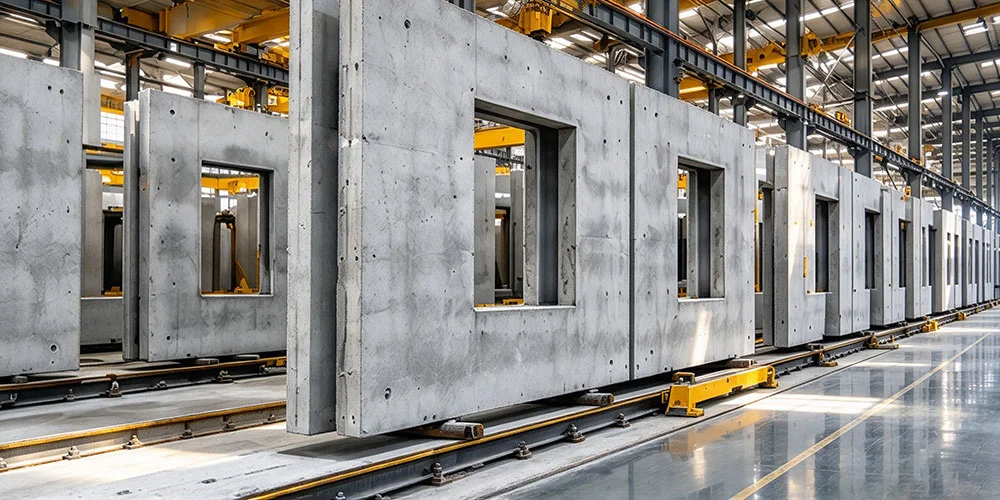
منتجات الخرسانة مسبقة الصب
Both microfibers and macro synthetic fibers may be useful in selected precast applications, but their roles differ.
Microfibers may be selected for early-age crack control in products susceptible to shrinkage cracking. Macro synthetic fibers may be suitable where post-cracking performance is required and has been verified.
Demolding, lifting, impact resistance, dimensional tolerances, and production conditions should all be considered before selecting the reinforcement system.
Can Microfibers and Macrofibers Be Used Together?
Yes, in some applications, different fiber types can be combined to address different performance requirements.
For example, a concrete mixture may use microfibers to help control plastic shrinkage cracking and macro synthetic fibers to provide post-cracking performance.
However, combining the two does not automatically improve every aspect of the concrete. The benefits depend on the mixture design, compatibility of the fibers, total fiber content, dispersion, workability, and the performance objectives.
Before combining fibers, consider the following:
- Define the function of each fiber. Establish whether the requirement concerns early-age cracking, hardened-concrete residual strength, or both.
- Check mixture compatibility. Confirm that the combined fiber system can be mixed, placed, and finished properly.
- Determine the appropriate dosage. Do not assume that the recommended dosage for either fiber can simply be added to the other without evaluation.
- Run trial batches. Check workability, fiber distribution, and the relevant performance properties.
- Verify the final concrete performance. Use tests appropriate to the project’s requirements.
A combined fiber system should be selected based on demonstrated performance, rather than the assumption that using more than one type of fiber will always produce better concrete.
How to Choose Between Macrofibers and Microfibers
Use the following decision process to narrow down the appropriate fiber category.
| متطلبات المشروع |
Initial Fiber Selection Direction |
What to Verify |
| Mainly plastic shrinkage crack control |
Microfiber |
Early-age crack-control performance, dosage, dispersion, and curing |
| Post-cracking load-carrying capacity |
Macrofiber |
Residual flexural strength and application-specific design requirements |
| Industrial floor with defined residual strength requirements |
Macrofiber may be considered |
Concrete performance at the proposed dosage and slab design |
| Residential slab with early-age cracking concerns |
Microfiber may be suitable |
Slab function, crack-control needs, mixture, and curing |
| Shotcrete requiring specified energy absorption |
Application-designed macrofiber system may be appropriate |
Relevant panel or other specified performance tests |
| Both early-age crack control and post-cracking performance |
A combined system may be considered |
Compatibility, workability, dosage, and testing of the complete mixture |
This table provides initial guidance, not a substitute for project-specific engineering.
These application categories overlap because one concrete project may have several performance objectives. The distinction is the primary function expected from the fiber, not simply the name of the application.
What Technical Data Should Buyers Request?
When comparing suppliers, request information that relates directly to the intended application.
For microfibers, useful information includes:
Fiber dimensions and material type.
Recommended dosage and mixing instructions.
Relevant early-age crack-control test results, where available.
Workability and dispersion guidance.
For macrofibers, request:
Fiber dimensions, geometry, and declared mechanical properties.
Recommended dosage for the intended application.
Residual flexural strength or toughness test results, where relevant.
Concrete mixture details and the test method used.
Technical guidance for mixing, placing, and finishing.
For both categories, confirm that the product specifications are consistent and that test results are relevant to your project. A supplier’s general product description is not enough to demonstrate performance in a specific concrete mixture.
Which Tests Help Verify Fiber Performance?
The appropriate test depends on the function of the fiber.
For plastic shrinkage crack control: ASTM C1579 is a relevant test method for evaluating plastic shrinkage cracking of restrained fiber-reinforced concrete. It may help assess the early-age crack-control performance of a suitable fiber system.
For residual flexural performance: ASTM C1609/C1609M evaluates the flexural performance of fiber-reinforced concrete beams, including residual strength at specified deflections.
For shotcrete toughness: ASTM C1550 may be used to evaluate the flexural toughness of fiber-reinforced concrete using round panels, where applicable to the project specification.
These methods evaluate different aspects of performance and are not interchangeable. The selected test should match the intended application and the requirements specified by the project engineer.
When comparing products, pay attention to the test method, concrete mixture, fiber dosage, specimen preparation, and reported results. Comparing results obtained under different conditions may lead to misleading conclusions.
الأسئلة المتكررة
Is macrofiber stronger than microfiber?
They are designed for different functions. Macro synthetic fibers can be designed to provide post-cracking load-carrying capacity, while microfibers are primarily used for early-age crack control. Actual performance depends on product properties, dosage, concrete mixture, and testing.
Can microfiber replace macrofiber?
Not automatically. A microfiber intended for plastic shrinkage crack control should not be assumed to provide the residual strength required from a macro synthetic fiber system. If post-cracking performance is specified, it must be demonstrated through suitable testing and engineering evaluation.
Can macrofibers prevent all concrete cracks?
No. Macro synthetic fibers can help control crack development and provide post-cracking performance, but they cannot eliminate every cause of cracking. Concrete mixture design, curing, joints, restraint, support conditions, and construction quality remain important.
Are polypropylene microfibers suitable for industrial floors?
They may be suitable when the main requirement is early-age crack control. If the floor also requires residual flexural strength or post-cracking load-carrying capacity, the design may need a macro synthetic fiber system or another verified reinforcement solution.
Can macrofibers replace steel fibers?
In selected applications, macro synthetic fibers may be considered as an alternative to steel fibers when the required concrete performance can be demonstrated and the design permits the substitution. This is a separate engineering decision from choosing between macrofibers and microfibers.
الخاتمة
Macrofibers and microfibers serve different but sometimes complementary roles in concrete.
Microfibers are primarily used to help control plastic shrinkage and other early-age cracking concerns. Macro synthetic fibers can provide crack bridging and post-cracking performance when the product, dosage, and concrete mixture are designed and verified for the intended application.
For concrete producers, contractors, and buyers, the most reliable selection method is to identify the cracking problem, define the required performance, and compare relevant test data.
If your project requires early-age crack control, begin by evaluating a suitable microfiber. If it requires post-cracking load-carrying capacity, investigate macro synthetic fibers and verify their performance against the project criteria.
استكشف TenaBrix Polypropylene Synthetic Microfiber product page and the TenaBrix Polypropylene Synthetic Macrofiber product range to compare product specifications and identify a suitable solution for your concrete application.
For application-specific requirements, اتصل بـ TenaBrix to discuss fiber selection, dosage, and technical documentation.