Synthetic fibers are widely used in concrete to help control cracking and improve performance. However, not all concrete fibers serve the same purpose. Two commonly used categories are polypropylene synthetic microfibers and macrofibers.
Although both can help control cracks, they differ in geometry, reinforcement mechanisms, and their contribution to concrete performance.
The main difference is that microfibers are primarily used to control early-age plastic shrinkage cracking, while properly designed macrofibers can provide post-cracking load-carrying capacity in hardened concrete. Their actual performance depends on fiber properties, dosage, concrete mixture, and the application.
For concrete producers, engineering contractors, and fiber buyers, understanding this distinction helps avoid selecting a fiber based only on price or appearance.
This guide compares macrofibers and microfibers in terms of crack control, performance, applications, and practical selection criteria.

What Is the Difference Between Macrofibers and Microfibers?
Macrofibers and microfibers are both synthetic reinforcement materials, commonly manufactured from polypropylene for concrete applications. Their main differences relate to their dimensions, intended functions, and performance requirements.
| Comparison Factor |
Microfibers |
Macrofibers |
| Typical geometry |
Fine, short fibers |
Longer fibers with larger cross-sections or more substantial profiles |
| Primary function |
Help control early-age plastic shrinkage and settlement cracking |
Help control cracking and provide post-cracking performance |
| Main reinforcement mechanism |
Distributed crack control through numerous fine fibers |
Crack bridging, bond, friction, and mechanical anchorage |
| Main performance focus |
Plastic shrinkage cracking and early-age crack development |
Residual flexural strength, toughness, and post-cracking behavior |
| Typical applications |
Concrete slabs, residential floor slabs, precast products, and mortar systems where early-age crack control is needed |
Industrial floors, slabs on ground, pavements, shotcrete, and selected precast applications |
| Structural contribution |
Generally not intended to provide structural post-cracking reinforcement |
May provide structural post-cracking reinforcement when designed and verified for the application |
| Key selection factors |
Fiber dimensions, dispersion, dosage, and early-age crack-control performance |
Fiber geometry, dosage, residual strength, toughness, and application-specific design requirements |
These categories are functional distinctions, not a universal classification based on one fixed length. Exact dimensions and classification criteria vary by product and applicable standard.
A useful starting point is to identify the cracking problem that needs to be addressed before choosing the fiber type.
How Do Microfibers Control Cracking in Concrete?
Plastic Shrinkage Cracking
Plastic shrinkage cracking can occur when water evaporates from a fresh concrete surface faster than it can be replaced by bleeding water. The resulting volume changes and tensile stresses may cause cracks before the concrete has fully hardened.
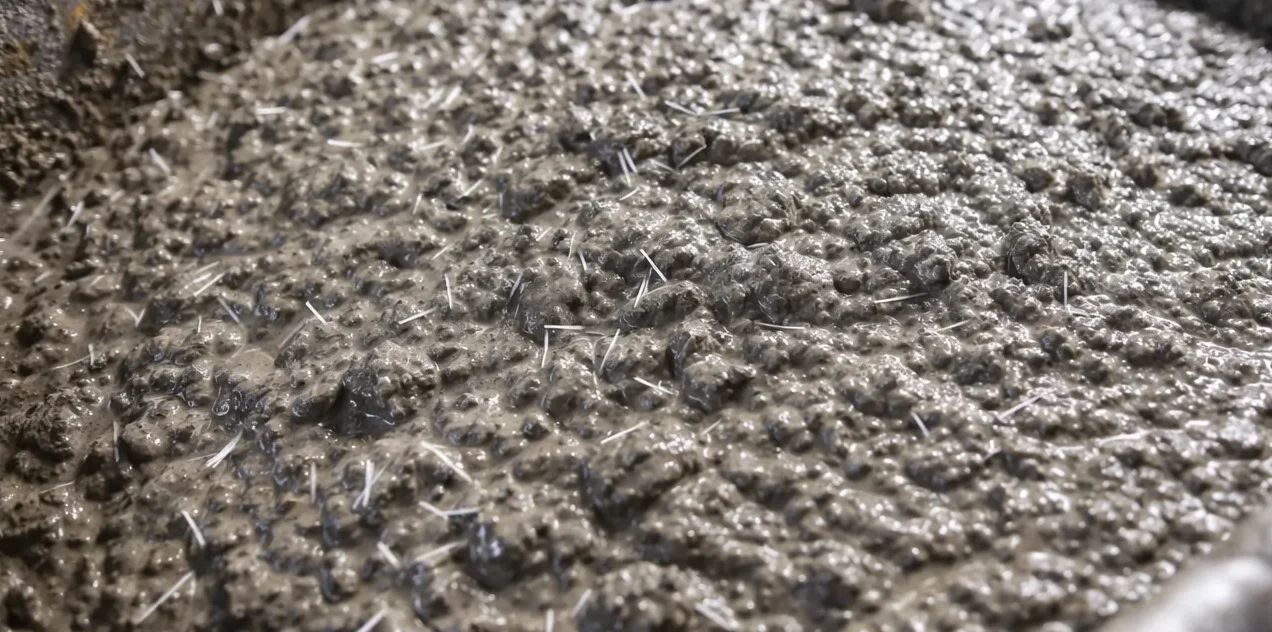
Polypropylene microfibers are distributed throughout the fresh concrete. When properly selected and dispersed, they can help limit the development and opening of plastic shrinkage cracks.
Their effectiveness depends on several factors:
- Fiber length, diameter, and number of fibers per unit volume.
- Fiber dosage and dispersion throughout the concrete.
- Concrete mixture proportions and workability.
- Environmental conditions, including temperature, wind, humidity, and evaporation rate.
- Curing practices and the timing of finishing operations.
Microfibers are particularly relevant when the project needs to manage early-age cracking in slabs, floor toppings, and other concrete elements with exposed surfaces.
However, adding microfiber does not eliminate the need for proper curing, mixture design, joint planning, and good placement practices.
Why Fiber Distribution Matters
Microfibers are generally fine and numerous. Their ability to help control cracking depends on how effectively they are distributed throughout the concrete.
Poor dispersion can create localized areas with insufficient fiber coverage. Excessive dosage or an unsuitable mixing procedure may also affect workability.
For this reason, fiber selection should consider both the material’s specifications and how it behaves in the actual concrete mixture.
Important: Microfibers primarily intended for plastic shrinkage crack control should not automatically be treated as a replacement for conventional reinforcement or as a means of providing structural residual strength. That function requires appropriate performance evidence and engineering verification.
How Do Macrofibers Reinforce Hardened Concrete?
Unlike microfibers primarily used for early-age crack control, macro synthetic fibers can be designed to carry tensile stress across cracks after the concrete has hardened.
Crack Bridging After Cracking
Concrete has limited tensile capacity. Once a crack forms, fibers crossing the crack can transfer stress between the separated concrete faces.
This mechanism, known as fiber bridging, can help the concrete continue carrying load after the initial crack forms.
The extent of this contribution depends on fiber properties, embedment, bond, orientation, dosage, and the characteristics of the concrete matrix.
Anchorage and Pullout Resistance
Macro synthetic fibers use a combination of interfacial bond, friction, surface texture, and fiber geometry to resist pullout.
Depending on the product design, embossed surfaces, curved profiles, or other geometrical features may contribute to mechanical anchorage. As a crack opens, the fibers can resist separation through the interaction between the fiber and surrounding concrete.
However, stronger anchorage does not automatically mean better overall concrete performance. Fiber rupture, pullout behavior, concrete properties, and the load–displacement response all affect the final result.
Residual Flexural Strength and Toughness
For applications that require post-cracking performance, the important question is not simply whether the concrete cracks, but how it behaves after cracking.
Residual flexural strength indicates the load-carrying capacity at specified deflections in an appropriate flexural test. Toughness or energy absorption describes the work sustained over a defined deformation range.
These properties are particularly important when evaluating macro synthetic fibers for industrial floors, pavements, shotcrete, and other applications where post-cracking behavior matters.
A product’s tensile strength or fiber length alone cannot establish its performance in reinforced concrete. Testing of the concrete mixture at the intended dosage is much more informative.
Macro Synthetic Fiber vs. Microfiber: Which Applications Need Each Type?
The best choice depends on the concrete’s cracking risks and the performance requirements of the finished element.
Industrial Floors and Slabs on Ground
Industrial floors may be exposed to wheel loads, equipment loads, shrinkage, and temperature changes.
Microfibers: May be appropriate when the main objective is to reduce plastic shrinkage cracking during the early stages of concrete placement and hardening.
Macro synthetic fibers: May be considered when the design also requires residual flexural strength and post-cracking load-carrying capacity.
For example, a slab may need early-age crack control as well as a defined post-cracking performance. In that case, selecting a macrofiber system may address the latter requirement, while early-age crack control still depends on the concrete mixture, environmental conditions, curing, and construction practices.These two types of fibers can be used in combination.
The choice should follow the slab design, loading conditions, joint layout, and specified performance criteria.
Residential Floor Slabs
For residential floor slabs where the primary concern is plastic shrinkage cracking, polypropylene microfibers may be suitable.
Macro synthetic fibers may be considered when the slab design requires additional post-cracking performance, but they should not be selected simply because they are larger or appear stronger.
The required reinforcement system depends on the slab’s structural function, ground support, loading, thickness, and applicable design provisions.
コンクリート舗装
Concrete pavements may experience shrinkage, temperature-related movement, traffic loading, and cracking caused by restraint or inadequate support.
Microfibers can help address certain early-age cracking concerns. Macro synthetic fibers may provide post-cracking performance when the fiber-reinforced concrete is designed and tested for that purpose.
Neither fiber type replaces the need for suitable pavement thickness, subgrade preparation, joint design, and curing.
Shotcrete and Tunnel Construction
Macro synthetic fibers are used in selected shotcrete applications where post-cracking performance and energy absorption are important.
Microfibers may serve a different purpose, such as early-age crack control, depending on the formulation and application.
For tunnel support or other engineered shotcrete systems, the fiber selection must satisfy the specified toughness, deformation, and support requirements. The two fiber categories should not be considered interchangeable.
プレキャストコンクリート製品
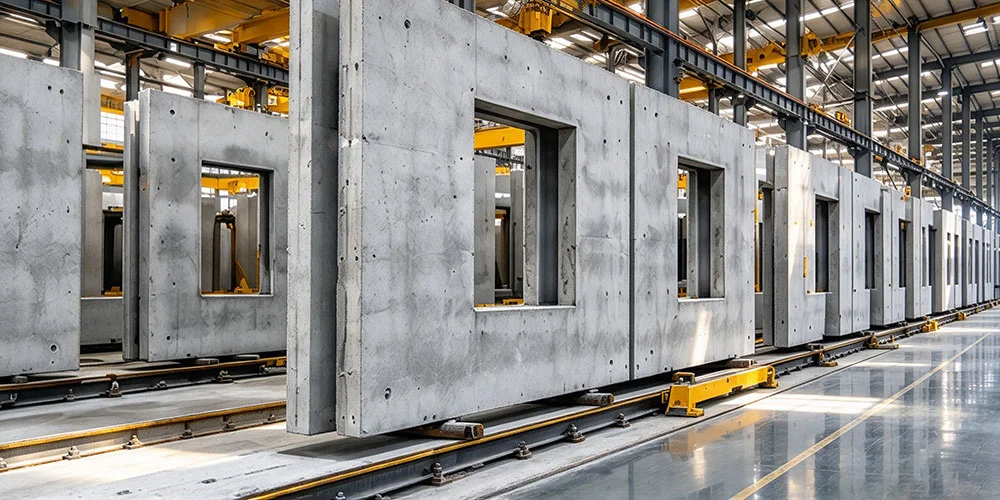
Both microfibers and macro synthetic fibers may be useful in selected precast applications, but their roles differ.
Microfibers may be selected for early-age crack control in products susceptible to shrinkage cracking. Macro synthetic fibers may be suitable where post-cracking performance is required and has been verified.
Demolding, lifting, impact resistance, dimensional tolerances, and production conditions should all be considered before selecting the reinforcement system.
Can Microfibers and Macrofibers Be Used Together?
Yes, in some applications, different fiber types can be combined to address different performance requirements.
For example, a concrete mixture may use microfibers to help control plastic shrinkage cracking and macro synthetic fibers to provide post-cracking performance.
However, combining the two does not automatically improve every aspect of the concrete. The benefits depend on the mixture design, compatibility of the fibers, total fiber content, dispersion, workability, and the performance objectives.
Before combining fibers, consider the following:
- Define the function of each fiber. Establish whether the requirement concerns early-age cracking, hardened-concrete residual strength, or both.
- Check mixture compatibility. Confirm that the combined fiber system can be mixed, placed, and finished properly.
- Determine the appropriate dosage. Do not assume that the recommended dosage for either fiber can simply be added to the other without evaluation.
- Run trial batches. Check workability, fiber distribution, and the relevant performance properties.
- Verify the final concrete performance. Use tests appropriate to the project’s requirements.
A combined fiber system should be selected based on demonstrated performance, rather than the assumption that using more than one type of fiber will always produce better concrete.
How to Choose Between Macrofibers and Microfibers
Use the following decision process to narrow down the appropriate fiber category.
| Project Requirement |
Initial Fiber Selection Direction |
What to Verify |
| Mainly plastic shrinkage crack control |
Microfiber |
Early-age crack-control performance, dosage, dispersion, and curing |
| Post-cracking load-carrying capacity |
Macrofiber |
Residual flexural strength and application-specific design requirements |
| Industrial floor with defined residual strength requirements |
Macrofiber may be considered |
Concrete performance at the proposed dosage and slab design |
| Residential slab with early-age cracking concerns |
Microfiber may be suitable |
Slab function, crack-control needs, mixture, and curing |
| Shotcrete requiring specified energy absorption |
Application-designed macrofiber system may be appropriate |
Relevant panel or other specified performance tests |
| Both early-age crack control and post-cracking performance |
A combined system may be considered |
Compatibility, workability, dosage, and testing of the complete mixture |
This table provides initial guidance, not a substitute for project-specific engineering.
These application categories overlap because one concrete project may have several performance objectives. The distinction is the primary function expected from the fiber, not simply the name of the application.
What Technical Data Should Buyers Request?
When comparing suppliers, request information that relates directly to the intended application.
For microfibers, useful information includes:
Fiber dimensions and material type.
Recommended dosage and mixing instructions.
Relevant early-age crack-control test results, where available.
Workability and dispersion guidance.
For macrofibers, request:
Fiber dimensions, geometry, and declared mechanical properties.
Recommended dosage for the intended application.
Residual flexural strength or toughness test results, where relevant.
Concrete mixture details and the test method used.
Technical guidance for mixing, placing, and finishing.
For both categories, confirm that the product specifications are consistent and that test results are relevant to your project. A supplier’s general product description is not enough to demonstrate performance in a specific concrete mixture.
Which Tests Help Verify Fiber Performance?
The appropriate test depends on the function of the fiber.
For plastic shrinkage crack control: ASTM C1579 is a relevant test method for evaluating plastic shrinkage cracking of restrained fiber-reinforced concrete. It may help assess the early-age crack-control performance of a suitable fiber system.
For residual flexural performance: ASTM C1609/C1609M evaluates the flexural performance of fiber-reinforced concrete beams, including residual strength at specified deflections.
For shotcrete toughness: ASTM C1550 may be used to evaluate the flexural toughness of fiber-reinforced concrete using round panels, where applicable to the project specification.
These methods evaluate different aspects of performance and are not interchangeable. The selected test should match the intended application and the requirements specified by the project engineer.
When comparing products, pay attention to the test method, concrete mixture, fiber dosage, specimen preparation, and reported results. Comparing results obtained under different conditions may lead to misleading conclusions.
よくあるご質問
Is macrofiber stronger than microfiber?
They are designed for different functions. Macro synthetic fibers can be designed to provide post-cracking load-carrying capacity, while microfibers are primarily used for early-age crack control. Actual performance depends on product properties, dosage, concrete mixture, and testing.
Can microfiber replace macrofiber?
Not automatically. A microfiber intended for plastic shrinkage crack control should not be assumed to provide the residual strength required from a macro synthetic fiber system. If post-cracking performance is specified, it must be demonstrated through suitable testing and engineering evaluation.
Can macrofibers prevent all concrete cracks?
No. Macro synthetic fibers can help control crack development and provide post-cracking performance, but they cannot eliminate every cause of cracking. Concrete mixture design, curing, joints, restraint, support conditions, and construction quality remain important.
Are polypropylene microfibers suitable for industrial floors?
They may be suitable when the main requirement is early-age crack control. If the floor also requires residual flexural strength or post-cracking load-carrying capacity, the design may need a macro synthetic fiber system or another verified reinforcement solution.
Can macrofibers replace steel fibers?
In selected applications, macro synthetic fibers may be considered as an alternative to steel fibers when the required concrete performance can be demonstrated and the design permits the substitution. This is a separate engineering decision from choosing between macrofibers and microfibers.
Conclusion
Macrofibers and microfibers serve different but sometimes complementary roles in concrete.
Microfibers are primarily used to help control plastic shrinkage and other early-age cracking concerns. Macro synthetic fibers can provide crack bridging and post-cracking performance when the product, dosage, and concrete mixture are designed and verified for the intended application.
For concrete producers, contractors, and buyers, the most reliable selection method is to identify the cracking problem, define the required performance, and compare relevant test data.
If your project requires early-age crack control, begin by evaluating a suitable microfiber. If it requires post-cracking load-carrying capacity, investigate macro synthetic fibers and verify their performance against the project criteria.
Explore the TenaBrix Polypropylene Synthetic Microfiber product page and the TenaBrix Polypropylene Synthetic Macrofiber product range to compare product specifications and identify a suitable solution for your concrete application.
For application-specific requirements, contact TenaBrix to discuss fiber selection, dosage, and technical documentation.