
 EN
EN  ES
ES  PT
PT  AR
AR  FR
FR 1. Objective
Fibers are introduced in drilling fluids and cementing systems primarily to:
- Control wellbore microcracks and fracture propagation
- Reduce fluid loss and maintain well integrity
- Enhance mechanical performance where required
This document provides a technical comparison between Polypropylene Fiber (PP Fiber) and Glass Fiber, offering guidance for fiber selection during engineering evaluation and project planning.
2. Mechanism of Action
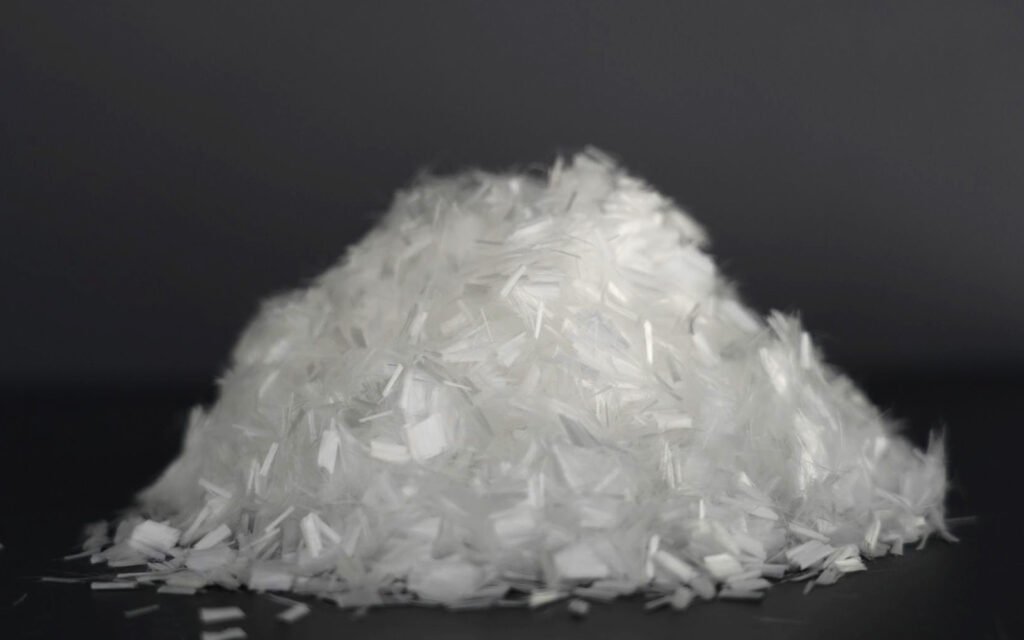
2.1 Polypropylene Fiber (PP Fiber)
PP fibers form a flexible three-dimensional network in the fluid or slurry system:
- Bridges microfractures and high-permeability channels
- Provides ductile constraint to limit crack propagation
- Improves impact and fatigue resistance
Engineering focus:
Leak control + crack resistance + system stability
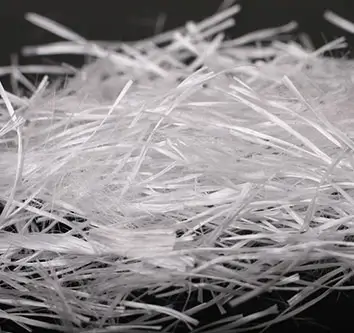
2.2 Glass Fiber
Glass fibers rely on their high elastic modulus and stiffness:
- Enhances compressive and flexural strength of the cured system
- Increases overall structural rigidity
Engineering focus:
Structural reinforcement rather than process control
3. Engineering Suitability Comparison
| Parameter | PP Fiber | Glass Fiber |
|---|---|---|
| Primary Purpose | Leak control, crack resistance, system stability | Mechanical strength and rigidity |
| Applicable Systems | Drilling fluids, cement slurries | Structural cements, composites |
| Dispersibility | Easy, shear-stable | Challenging, requires careful mixing |
| Settling Risk | Very low | Moderate to high |
| Impact on Pumping / Circulation | Minimal | May increase equipment wear |
| Chemical Resistance (Acid / Alkali / Salts) | Excellent | Moderate in alkaline environments |
| Operational Window | Wide | Narrow |
| Field Controllability | High | Moderate to low |
4. Impact on Drilling and Cementing Risks
4.1 PP Fiber
- Reduces fluid loss probability
- Minimizes induced fractures in the wellbore
- Lowers gas migration and micro-annulus risks
- Increases operational safety margin
- Characterization: Risk-control-oriented material, suitable for most field conditions.
4.2 Glass Fiber
- Enhances cured system strength
- Requires precise slurry design, mixing, and pumping control
- Poor dispersion can cause localized defects
- Characterization: Performance-enhancement material with limited general applicability.
5. Typical Application Guidance
1. Drilling fluids (especially fluid-loss control)
Recommended: PP Fiber
2. Conventional cementing, microcrack control
Recommended: PP Fiber
3. High-strength structural applications with explicit mechanical requirements
Consider: Glass Fiber (requires field verification)
6. Technical Conclusion
Polypropylene fibers are the preferred solution in oilfield drilling operations, offering a balance of safety, system stability, and field operability.
Glass fibers are suitable for specialized structural reinforcement applications, but are not recommended as a general-purpose fiber in drilling or cementing fluids.
7. Optional Additions
Recommended PP fiber lengths and dosage ranges for drilling fluids and cement slurries
Field application examples (non-specific to wells)
English version for bid documents, technical clarifications, or client presentations
Integration strategies with fiber-based LCM formulations
