





Warehouse floors are expected to support heavy loads, constant forklift traffic, pallet racking systems, and daily industrial operations. When concrete floors crack, they not only affect appearance but can also lead to costly repairs, production downtime, and safety risks.
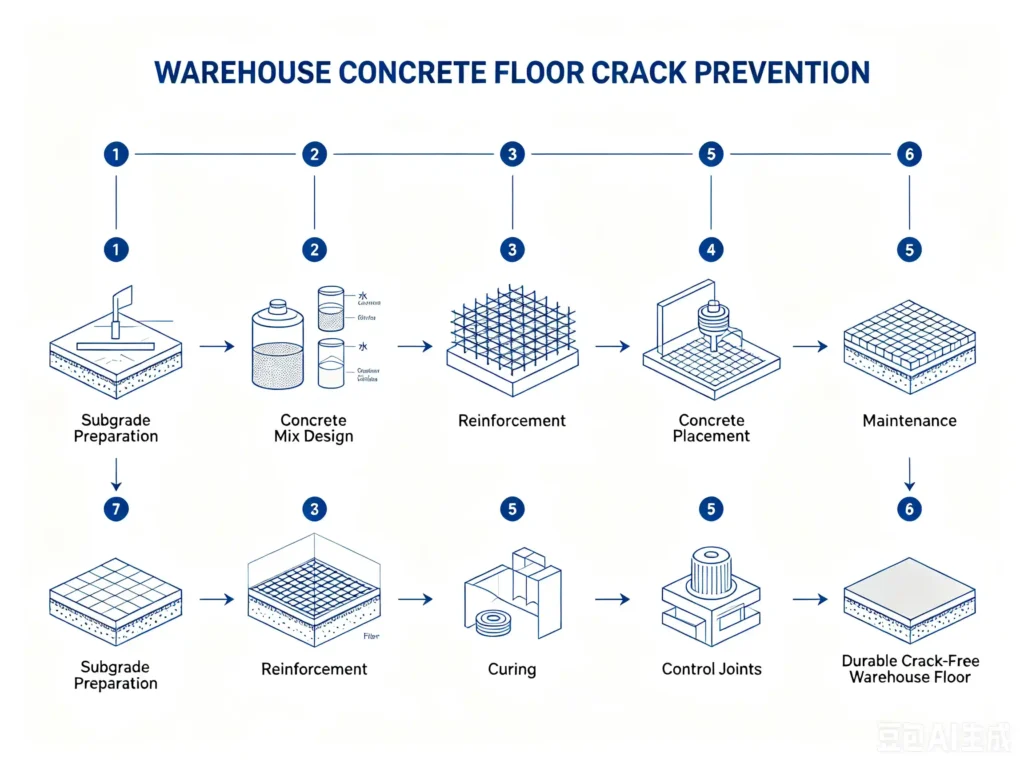
Fortunately, most concrete floor cracks can be prevented with proper planning, quality materials, and correct construction methods.
In this guide, we’ll explain why warehouse concrete floors crack, how to prevent different types of cracking, and what reinforcement solutions work best for modern industrial buildings.
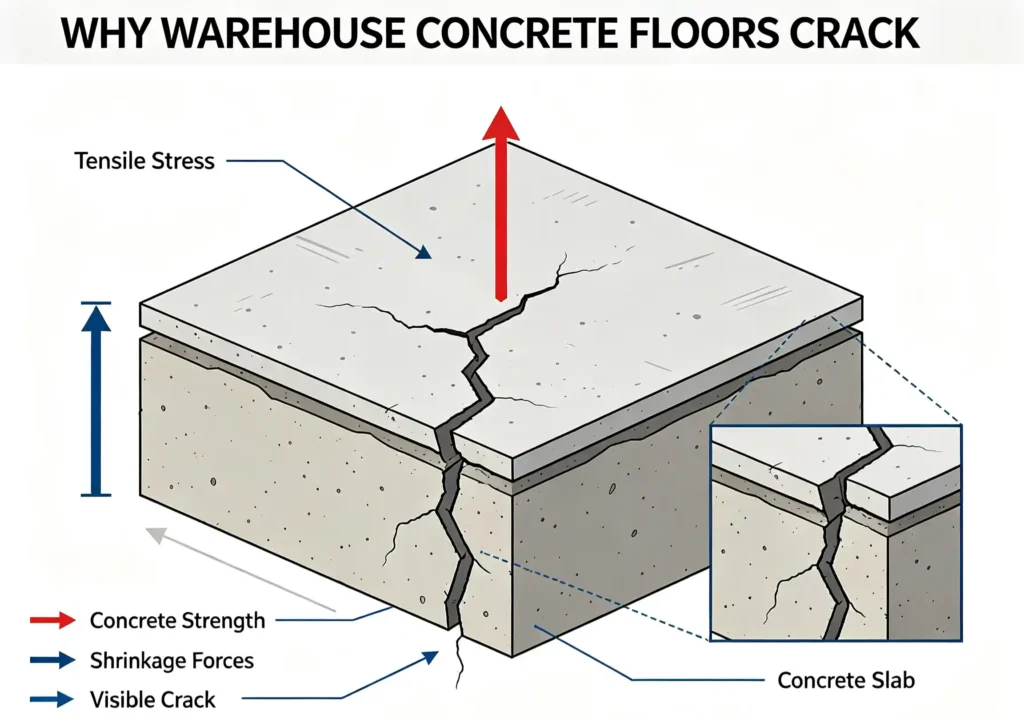
Why Do Warehouse Floors Crack?
Concrete cracks. That’s just what it does. But warehouse floors crack more than most — and for specific, predictable reasons. Here are the 5 main causes of warehouse floor cracks:
1. Plastic Shrinkage Cracking (First 24 Hours)
When fresh concrete dries too fast — usually because of wind, heat, or low humidity — the surface shrinks faster than the concrete underneath. The result? A web of shallow cracks that appear within hours of pouring, before the concrete has even set.
This is the #1 cause of early cracking in warehouse slabs, and it’s completely preventable with the right fiber.
2. Drying Shrinkage Cracking (Weeks to Months)
As concrete cures and loses moisture over time, it shrinks. If the slab is restrained — by walls, columns, or the sub-base — the shrinkage creates internal tension. Eventually, something has to give. The concrete cracks.
3. Load-Induced Cracking (Ongoing)
Warehouse floors carry heavy, repetitive loads: forklifts, loaded pallets, rack systems. Over time, these loads flex the slab. Without reinforcement, small cracks grow into major fractures.
4. Joint Failures
Construction joints and control joints are weak points by design. But when joints spall, crack, or shift under forklift traffic, they become the starting point for larger floor failures.
5. Sub-Base Issues
If the ground beneath the slab settles unevenly, the slab loses support and cracks under its own weight. Fiber can’t fix bad ground preparation, but it can help bridge minor settlement issues.

How Synthetic Fiber Prevents Each Type of Crack
Here’s the key point most people miss: different fibers prevent different types of cracks. There is no single “magic fiber” that handles everything.
Micro Fiber: Your First Line of Defense
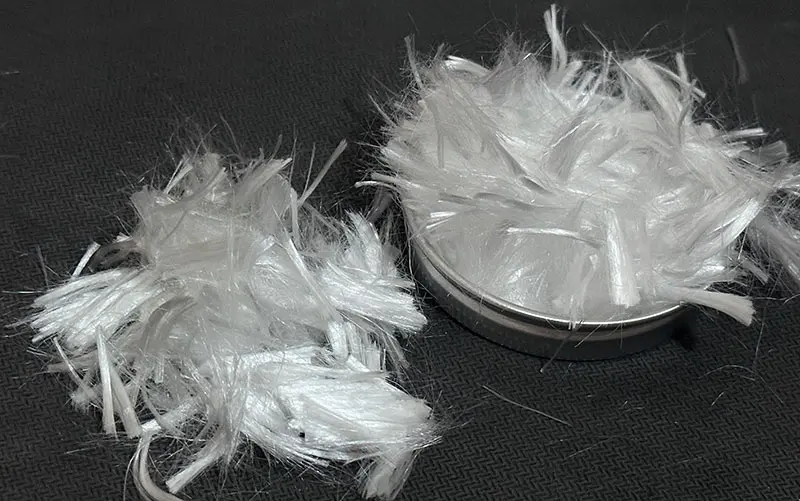
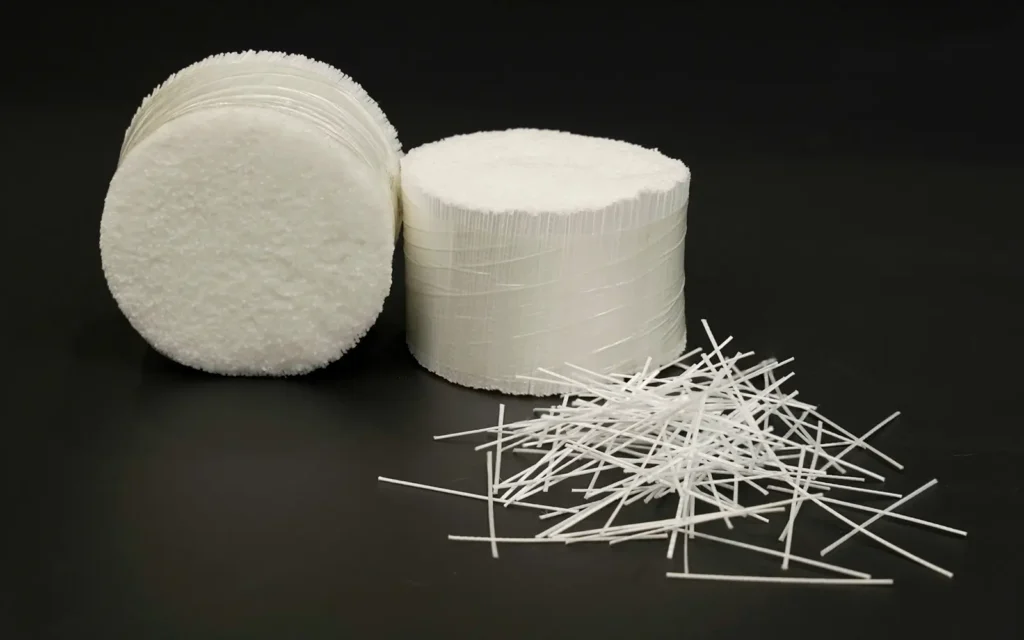
Micro synthetic fiber (typically polypropylene, 6–19mm length) works in the first 24 hours. Think of it as a microscopic net that holds wet concrete together while it’s still soft.
- What it prevents: Plastic shrinkage cracking — those early surface cracks
- How it works: The fibers distribute across the concrete matrix and resist the tensile forces that cause the surface to tear apart as it dries
- Dosage: Just 0.9 kg/m³ is enough for most warehouse slabs
- Cost impact: Minimal — typically less than $1.50 per cubic meter of concrete
Micro fiber is like adding rebar for the first day of the concrete’s life. Once the concrete hardens, micro fiber’s job is largely done — but if it wasn’t there, the damage is already permanent.
Macro Fiber: Structural Insurance
Macro synthetic fiber (polypropylene, 40–60mm, embossed profile) works after the concrete has hardened. It’s the long-term reinforcement that keeps cracks from opening up over years of forklift traffic.
- What it prevents: Drying shrinkage cracks and load-induced cracks
- How it works: When a crack starts to form, the macro fibers bridge across it and hold the concrete together. The slab stays in one piece instead of splitting apart
- Dosage: 4–7 kg/m³ for warehouse floors (5 kg/m³ is the sweet spot for most applications)
- What it replaces: Traditional welded wire mesh — at comparable or lower installed cost. For a detailed comparison, see our article on macro fiber vs steel fiber for industrial floors.
If micro fiber is the safety net for the first day, macro fiber is the safety net for the next 20 years. Every time a forklift drives over a tiny crack, the macro fibers hold it together and stop it from growing.
Using Both Together: The Hybrid Approach
For warehouse floors, the best practice is to use both. Here’s why:
| Micro Fiber Only | Macro Fiber Only | Hybrid (Micro + Macro) | |
|---|---|---|---|
| Prevents early surface cracks | ✅ | ❌ | ✅ |
| Prevents long-term structural cracks | ❌ | ✅ | ✅ |
| Replaces steel mesh | ❌ | ✅ | ✅ |
| Handles forklift traffic | ❌ | ✅ | ✅ |
| Extra cost vs plain concrete | ~$1.50/m³ | ~$6–9/m³ | ~$7–10/m³ |
| Recommendation | Not enough alone | Good | Best practice |
In many warehouse projects, a hybrid steel fiber and polypropylene fiber system adds approximately $7–10 per cubic meter of concrete (depending on fiber dosage and local material prices). For a typical 200 mm warehouse slab, that’s about $1.40–2.00 per square meter—far less than repairing cracked floors, where epoxy injection typically costs $15–50 per linear meter of crack and full slab replacement can exceed $50–100 per square meter. For exact dosage rates by application, check our concrete fiber dosage guide.
5 Practical Tips to Get the Most Out of Fiber in Your Warehouse Floor
1. Add Fiber to the Mixer the Right Way
Don’t add fiber directly to dry materials. Instead, add it after the aggregates and about 80% of the mixing water has been added. Mix for at least 90 seconds (or according to the fiber manufacturer’s recommendations) to ensure even fiber distribution and prevent fiber balls.
2. Don’t Skip Micro Fiber to Save a Few Dollars
Micro polypropylene fiber typically adds only a few dollars per cubic meter to the concrete cost, but it plays a critical role in controlling early-age plastic shrinkage cracks. Macro fiber improves the concrete’s structural performance after it hardens, while micro fiber helps reduce cracking during the first few hours after placement. Skipping micro fiber to save a small amount of money can result in much higher repair costs later.
3. Optimize Joint Spacing with Proper Design
Depending on the slab design and fiber dosage, macro fiber reinforcement may allow joint spacing to increase from the typical 4–6 meters to 6–8 meters. Fewer joints mean fewer potential weak points, lower maintenance costs, and a longer-lasting floor. However, joint spacing should always be determined by a qualified structural engineer based on project requirements.
4. Cure the Concrete Properly
Fiber reinforcement is not a substitute for proper curing. Keep the concrete surface moist for at least 7 days, or apply a suitable curing compound immediately after finishing. Fiber helps control cracks caused by internal stresses, while proper curing minimizes surface shrinkage and improves concrete strength and durability.
5. Run a Trial Batch Before Full-Scale Placement
Before placing hundreds or thousands of cubic meters of concrete, perform a small trial batch using your actual mix design and fiber dosage. Evaluate workability, finishability, and fiber distribution to identify any issues before construction begins. A short trial can help prevent costly delays, repairs, or rework on the job site.
Common Questions About Warehouse Floor Fiber
Can synthetic fiber completely replace steel mesh in a warehouse floor?
In most warehouse and distribution center applications — yes. Macro synthetic fiber at 5–7 kg/m³ provides equivalent or better crack control than traditional mesh, with faster installation and lower labor costs. The exception is suspended slabs or slabs on piles, where structural engineering requirements may still require steel reinforcement.
Will fiber affect the surface finish of my polished floor?
Micro fiber at standard dosages has no visible effect on surface finish. Macro fiber can occasionally cause minor fiber protrusion at the surface, but this is manageable with proper finishing techniques. For polished concrete floors, we recommend micro fiber at 0.9 kg/m³ as the primary reinforcement.
How much does it cost to add fiber to a warehouse floor?
For a typical hybrid fiber system (micro + macro), expect to add approximately $7–10 per cubic meter of concrete. For a 200 mm-thick slab, that equals about $1.40–2.00 per square meter. In many projects, this is less than the cost of welded wire mesh materials alone, even before considering the labor and time savings from eliminating mesh installation.
Do building codes approve fiber reinforcement?
Synthetic fiber reinforcement is recognized by ACI 544, EN 14889-2, and ASTM C1116. It’s widely accepted for slab-on-grade applications. For structural slabs, check with your local building code and structural engineer.
My warehouse floor already has cracks. Can fiber help?
Fiber is a preventive measure, not a repair product. If your floor already has cracks, you’ll need epoxy injection, routing and sealing, or a bonded overlay. But if you’re pouring a new floor or an overlay on top of the existing one, fiber in the new concrete will prevent the cracks from coming back.
Ready to Stop Cracks Before They Start?
The right fiber specification depends on your slab thickness, load requirements, joint layout, and sub-base conditions. At TenaBrix, we’ve supplied fiber for warehouse floors across 30+ countries — from small logistics facilities to major distribution centers.
Get a free fiber recommendation for your warehouse floor →
Send us your project details and we’ll provide a specific dosage recommendation, cost estimate, and technical data sheet — usually within 24 hours.