





Why Add Fiber to Concrete?
Concrete is the world’s most widely used construction material, but it has a fundamental weakness: it’s strong in compression but weak in tension. When tensile stress exceeds the concrete’s capacity — whether from shrinkage during curing, temperature changes, or applied loads — cracks form.
Once cracks appear, they create a cascade of problems:
- Water and chemical ingress accelerates rebar corrosion
- Freeze-thaw cycles widen existing cracks
- Structural integrity degrades over time
- Maintenance costs multiply
Traditional reinforcement with steel rebar or welded wire mesh addresses these issues at a macro level, but it does nothing to stop micro-cracking that begins within hours of pouring.
This is where fiber reinforcement comes in.
What Problems Does Fiber Solve?
Fiber reinforcement works at the micro and meso scale — the level where cracks begin. Instead of relying on a few large steel bars placed at specific locations, fiber creates a three-dimensional reinforcement network throughout the entire concrete matrix.
| Problem | Without Fiber | With Fiber |
|---|---|---|
| Plastic shrinkage cracking | Cracks form within 3-6 hours of pouring | Reduced by up to 80% |
| Hardened concrete cracking | Cracks propagate under load | Bridged by fibers, limiting width |
| Impact resistance | Brittle failure | Energy absorption increased 5-10x |
| Freeze-thaw durability | Rapid degradation | Fiber network limits crack propagation |
| Abrasion resistance | Surface wear | Improved surface integrity |
Fiber vs Traditional Reinforcement: Key Differences
Fiber doesn’t replace structural rebar in most applications. Instead, it complements it:
- Rebar provides primary structural strength — handling calculated tensile loads
- Welded wire mesh provides secondary crack control — but only at one plane
- Fiber provides three-dimensional micro-reinforcement — stopping cracks before they start
In certain applications — particularly slabs-on-ground, shotcrete, and precast elements — fiber can partially or fully replace welded wire mesh and even light rebar, reducing labor costs and construction time.
Types of Concrete Fiber: A Complete Overview
Choosing the right fiber starts with understanding the categories. Fibers are classified by material, size, and function.
Micro Synthetic Fiber (Crack Control)
Micro synthetic fibers are thin — typically 6-18 mm long with diameters measured in microns — and are designed to disperse into millions of individual filaments throughout the concrete mix.
What they do: Control plastic shrinkage cracking during the first 24 hours of curing. They do not provide structural strength.
Common materials: Polypropylene (PP), polyester (PET), nylon
Typical dosage: 0.6–1.0 kg/m³
Best for:
- Residential slabs and driveways
- Mortar and stucco
- Precast architectural elements
- Topping slabs and overlays
Our product: Polypropylene Micro Synthetic Fiber
Important: Micro fiber is not a substitute for structural reinforcement. If you need load-bearing capacity, look at macro fiber or steel fiber.
Macro Synthetic Fiber (Structural Reinforcement)
Macro synthetic fibers are engineered structural elements — typically 30-60 mm long with deformed surfaces (embossed, crimped, or twisted) that create mechanical anchorage within the concrete.
What they do: Provide post-crack reinforcement, improve flexural toughness, and enhance impact resistance. In many slab-on-ground and shotcrete applications, they can replace steel mesh or steel fibers entirely.
Common materials: Polypropylene (PP), blended polymers
Typical dosage: 3–8 kg/m³
Best for:
- Industrial flooring and warehouses
- Shotcrete tunnel linings
- Precast concrete elements
- Pavement and hardstands
Our product: Polypropylene Macro Synthetic Fiber
Key advantage over steel fiber: Zero corrosion risk, lighter weight, safer handling, and often lower total installed cost.
Steel Fiber (Heavy-Duty Applications)
Steel fibers are the traditional workhorse for heavy industrial applications. Typically 30-60 mm long with hooked ends for mechanical anchorage, they deliver high tensile strength and stiffness.
What they do: Provide structural reinforcement in high-load, high-abrasion environments. Steel fiber can partially or fully replace rebar in heavily loaded slabs.
Common materials: Low-carbon steel, stainless steel
Typical dosage: 20–40 kg/m³
Best for:
- Heavy industrial floors (forklift traffic >10 tons)
- Port and container yards
- Heavy-duty pavements
- Seismic-resistant structures
Our product: Steel Fibers for Concrete
When to choose steel over macro synthetic: When extreme point loads or very high stiffness is required, steel fiber still leads. For most other applications, macro synthetic fiber offers comparable performance with better corrosion resistance.
Specialty Fibers
Beyond the standard categories, several specialty fibers address specific engineering challenges:
| Fiber Type | Key Property | Best Application |
|---|---|---|
| PAN (Polyacrylonitrile) Fiber | Very high tensile strength (≥500 MPa), excellent crack control | Bridge decks, airport runways, marine structures |
| Basalt Fiber | Natural mineral, high temperature resistance (up to 700°C) | Fire-resistant structures, infrastructure in extreme climates |
| Glass Fiber (AR-Glass) | High tensile strength, alkali-resistant | Architectural panels, decorative concrete |
| Cellulose Fiber | Natural, biodegradable, excellent water retention | Mortar, plaster, shotcrete (prevents sagging) |
| PVA (Polyvinyl Alcohol) Fiber | Exceptional bond with cement matrix | ECC (Engineered Cementitious Composites), high-performance repair |
Our specialty fiber products:
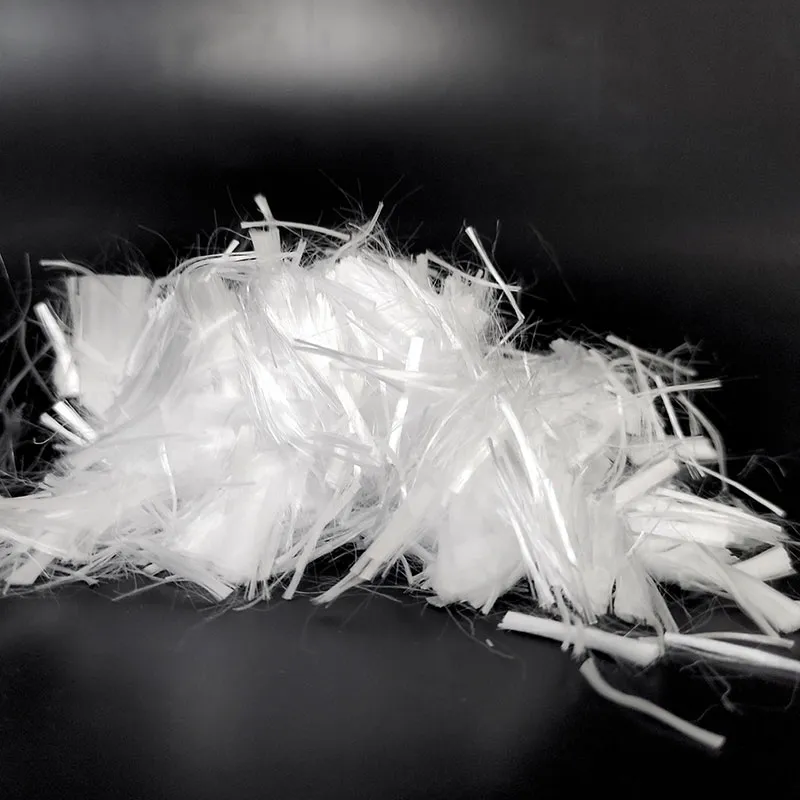
Micro Synthetic Fiber
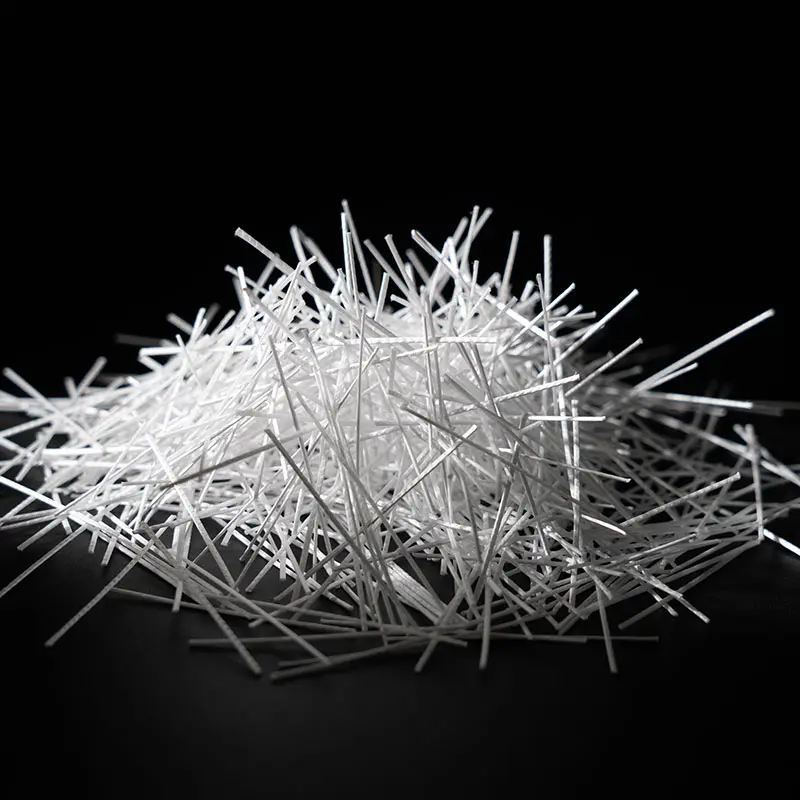
Macro Synthetic Fibe
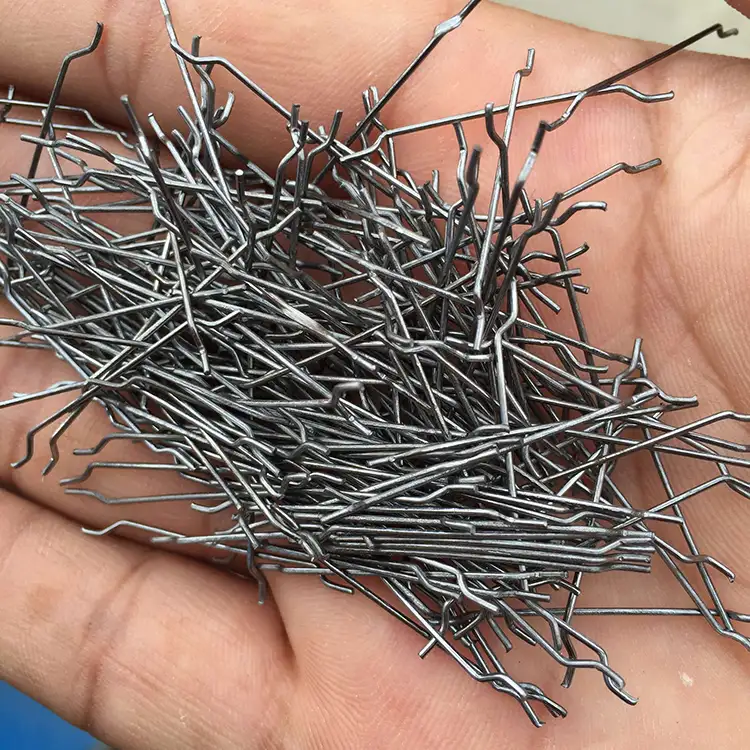
Steel Fiber
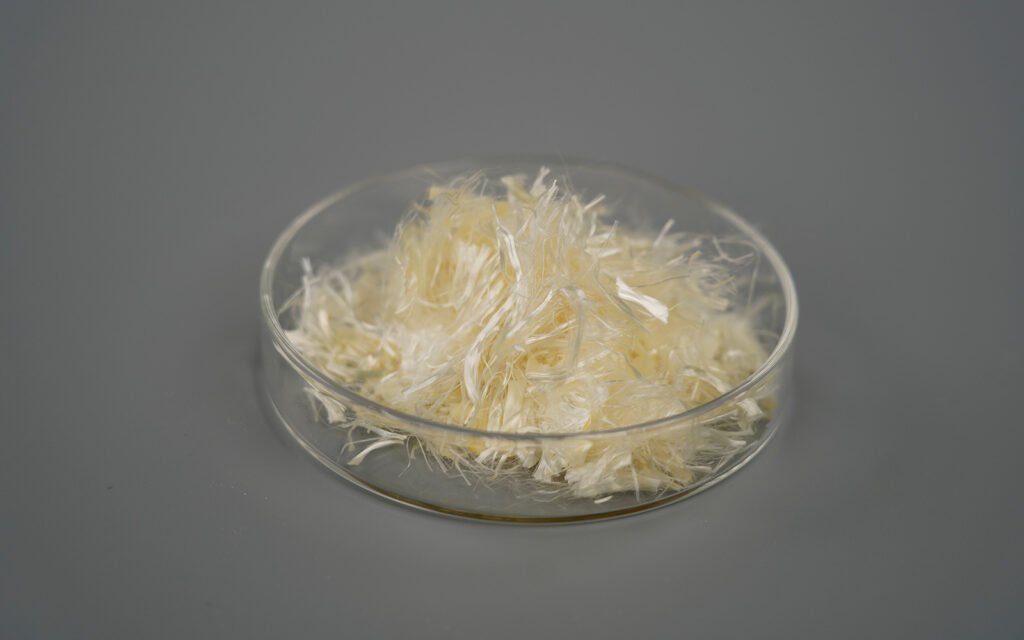
PAN Fiber
How to Choose the Right Fiber: Decision Framework
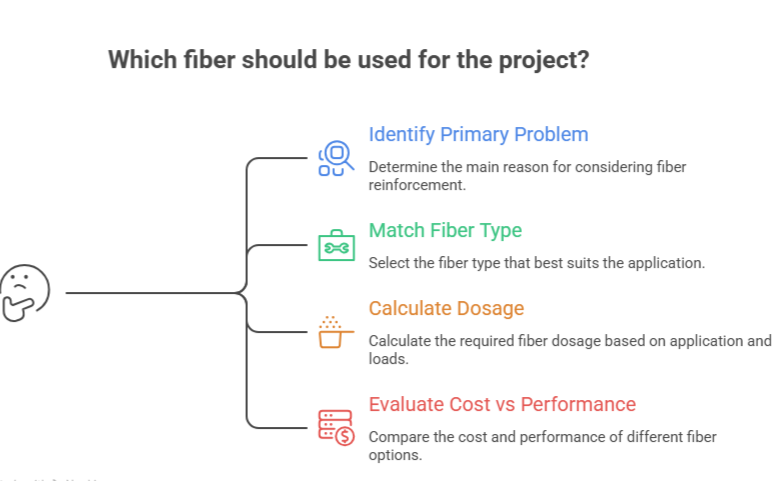
Choosing the right fiber isn’t about finding the “best” one — it’s about matching fiber properties to your project’s specific needs. Follow this four-step framework.
Step 1: Identify Your Primary Problem
Ask yourself: what is the main reason I’m considering fiber reinforcement?
| Primary Problem | Fiber Solution |
|---|---|
| Plastic shrinkage cracking (first 24 hours) | Micro synthetic fiber |
| Cracking under service loads | Macro synthetic fiber or steel fiber |
| Corrosion in aggressive environments | Macro synthetic or PAN fiber |
| Impact and abrasion resistance | Macro synthetic fiber or steel fiber |
| Fire resistance | Basalt fiber |
| Reducing rebar/mesh congestion | Macro synthetic fiber (replaces mesh) |
| Extreme point loads (>10-ton forklifts) | Steel fiber |
| Environmental/sustainability goals | Basalt, cellulose, or macro synthetic (lower carbon than steel) |
Step 2: Match Fiber Type to Application
| Application | Recommended Fiber | Dosage | Notes |
|---|---|---|---|
| Residential slab | Micro PP fiber | 0.6–0.9 kg/m³ | Crack control only; rebar still needed for structural support |
| Warehouse floor (light-medium traffic) | Macro synthetic fiber | 3–5 kg/m³ | Can replace mesh; combine with micro fiber for best results |
| Heavy industrial floor (>10t forklifts) | Steel fiber | 20–35 kg/m³ | Or hybrid: steel + macro synthetic |
| Shotcrete tunnel lining | Macro synthetic fiber | 4–6 kg/m³ | Better safety profile than steel fiber |
| Precast concrete element | Macro synthetic or steel fiber | 3–7 kg/m³ | Depends on structural requirements |
| Bridge deck overlay | PAN fiber | 1–2 kg/m³ | Superior crack control and corrosion resistance |
| Airport runway | PAN or macro synthetic fiber | 3–5 kg/m³ | High fatigue resistance required |
| Marine structure | PAN fiber or macro synthetic | 3–6 kg/m³ | Zero corrosion risk essential |
| Decorative/architectural concrete | Micro PP or AR-glass fiber | 0.6–1.0 kg/m³ | Minimal impact on surface finish |
| Fire-rated structure | Basalt fiber | 2–4 kg/m³ | Temperature resistance up to 700°C |
Step 3: Calculate Required Dosage
Dosage is not one-size-fits-all. It depends on:
- Application type — structural vs. non-structural
- Expected loads — light, medium, or heavy traffic
- Design requirements — specified flexural toughness or energy absorption
- Fiber type — micro fibers use lower dosages than macro fibers
| Application | Micro Fiber (kg/m³) | Macro Fiber (kg/m³) | Steel Fiber (kg/m³) |
|---|---|---|---|
| Residential slabs | 0.6–0.9 | — | — |
| Commercial slabs | 0.6–0.9 | 3–4 | — |
| Light industrial floors | 0.9 | 4–5 | 15–20 |
| Medium industrial floors | 0.9 | 5–7 | 20–30 |
| Heavy industrial floors | — | 7–9 | 30–40 |
| Shotcrete (temporary) | — | 3–4 | — |
| Shotcrete (permanent) | — | 4–6 | 25–35 |
| Precast (non-structural) | 0.9 | 3–4 | — |
| Precast (structural) | — | 5–7 | 20–30 |
| Pavement/hardstand | — | 4–6 | 20–30 |
| Bridge deck overlay | — | — | — (Use PAN: 1–2) |
Pro tip: For industrial floors, consider a hybrid approach: 0.9 kg/m³ of micro fiber for early-age crack control + 4-6 kg/m³ of macro synthetic fiber for post-crack structural performance. This combination delivers the best of both worlds.
Step 4: Evaluate Cost vs Performance
Fiber cost should be evaluated as part of total installed cost, not just material price:
| Factor | Macro Synthetic Fiber | Steel Fiber |
|---|---|---|
| Material cost per kg | Lower | Higher |
| Dosage required | 3–8 kg/m³ | 20–40 kg/m³ |
| Handling & mixing | Easy, lightweight | Heavy, requires care |
| Pumping wear | Minimal | Higher equipment wear |
| Corrosion maintenance | Zero | Potential long-term cost |
| Safety (worker injury) | No sharp edges | Cut/puncture risk |
| Surface finishing | Easier | May require grinding |
Bottom line: In most slab-on-ground and shotcrete applications, macro synthetic fiber delivers equal or better performance at 15-30% lower total installed cost than steel fiber.
Application-Specific Fiber Recommendations
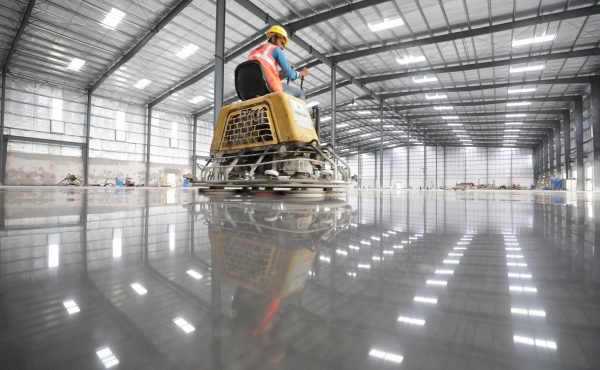
Industrial Flooring
Industrial floors face unique challenges: heavy point loads from forklifts, continuous abrasion from wheeled traffic, and large surface areas prone to shrinkage cracking.
Recommended approach:
- Light traffic (warehouses, retail): Micro PP fiber (0.9 kg/m³) for crack control
- Medium traffic (distribution centers, light manufacturing): Hybrid — micro (0.9 kg/m³) + macro synthetic (4-5 kg/m³)
- Heavy traffic (steel mills, heavy manufacturing): Steel fiber (25-35 kg/m³) or high-dosage macro synthetic (7-9 kg/m³)
- Chemical exposure: Macro synthetic fiber — zero corrosion, excellent chemical resistance
Learn more: Industrial Flooring Fiber Solutions →
Shotcrete & Tunneling
Shotcrete applications demand fibers that mix easily, pump reliably, and provide immediate crack control in often challenging underground conditions.
Recommended approach:
- Macro synthetic fiber (4-6 kg/m³) is now the industry standard for tunnel shotcrete
- Advantages over steel fiber: safer handling (no rebound injuries), lower pump wear, no corrosion in humid tunnel environments
- For temporary support: 3-4 kg/m³
- For permanent lining: 4-6 kg/m³
Learn more: Shotcrete Fiber Solutions →
Precast Concrete
Precast elements benefit from fiber in multiple ways: reduced cracking during demolding and transport, improved impact resistance, and potential elimination of secondary mesh reinforcement.
Recommended approach:
- Non-structural elements (cladding, architectural panels): Micro PP fiber (0.9 kg/m³)
- Structural elements (pipes, manholes, barriers): Macro synthetic fiber (4-7 kg/m³)
- High-strength structural elements: Steel fiber (20-30 kg/m³)
Learn more: Precast Fiber Solutions →
Bridge Decks & Infrastructure
Infrastructure projects have the highest demands: decades-long service life, exposure to de-icing salts and marine environments, and heavy cyclic loading.
Recommended approach:
- Bridge deck overlays: PAN fiber (1-2 kg/m³) — superior crack control and corrosion resistance
- Approach slabs: Macro synthetic fiber (4-5 kg/m³)
- Barrier walls: Macro synthetic or PAN fiber
Learn more about PAN fiber for bridge decks →
Residential Slabs
For home builders, the primary concern is callbacks due to slab cracking.
Recommended approach:
- Micro PP fiber (0.6-0.9 kg/m³) provides excellent shrinkage crack control at minimal cost
- Adds approximately $3-5 per cubic meter — a fraction of the cost of repairing a cracked slab
Fiber Dosage Guide by Application

| Application | Fiber Type | Recommended Dosage | Expected Performance |
|---|---|---|---|
| Residential slabs | Micro PP | 0.6–0.9 kg/m³ | Plastic shrinkage crack reduction: 60-80% |
| Commercial slabs | Micro PP + Macro synthetic | 0.9 + 3–4 kg/m³ | Early-age + post-crack control |
| Light industrial floor | Macro synthetic | 4–5 kg/m³ | Replaces wire mesh; flexural toughness ≥2.5 MPa |
| Medium industrial floor | Macro synthetic | 5–7 kg/m³ | For forklifts up to 5 tons |
| Heavy industrial floor | Steel fiber | 25–35 kg/m³ | For forklifts over 10 tons; Re,3 ≥50% |
| Warehouse (ASRS) | Macro synthetic | 5–7 kg/m³ | Tight joint tolerances; flatness FF50+ |
| Cold storage (-30°C) | Macro synthetic | 5–6 kg/m³ | Maintains toughness at low temperatures |
| External hardstand | Macro synthetic | 4–6 kg/m³ | UV-stable; no corrosion |
| Shotcrete (temporary) | Macro synthetic | 3–4 kg/m³ | Energy absorption ≥500 J (EFNARC panel test) |
| Shotcrete (permanent) | Macro synthetic | 4–6 kg/m³ | Energy absorption ≥700-1000 J |
| Precast pipe | Macro synthetic or steel | 4–7 or 20–30 kg/m³ | Improved handling strength |
| Precast architectural | Micro PP | 0.9 kg/m³ | Surface crack prevention |
| Bridge deck overlay | PAN fiber | 1–2 kg/m³ | Crack reduction 80%+; zero corrosion |
| Airport runway | PAN or macro synthetic | 3–5 kg/m³ | Fatigue life improvement 40-50% |
| Marine structure | PAN or macro synthetic | 3–6 kg/m³ | Chloride-resistant; no corrosion |
| Tunnel segment | Macro synthetic or steel | 4–6 or 25–35 kg/m³ | Fire resistance + structural capacity |
Common Mistakes When Choosing Concrete Fiber
Mistake 1: Using Micro Fiber When You Need Structural Reinforcement
Micro fiber controls plastic shrinkage cracking. It does not provide structural strength. If you’re trying to replace welded wire mesh or increase load capacity, you need macro synthetic fiber or steel fiber.
Mistake 2: Assuming All Macro Fibers Are the Same
Not all macro synthetic fibers perform equally. Look for:
- Surface deformation (embossed, crimped, or twisted) — smooth fibers have poor bond
- Aspect ratio — longer fibers generally provide better post-crack performance
- Material quality — 100% virgin polymer vs. recycled content affects consistency
Mistake 3: Overlooking Dosage Requirements
Under-dosing is the most common cause of poor fiber performance. “A little bit of fiber” won’t do the job. Follow manufacturer recommendations based on your specific application and expected loads.
Mistake 4: Ignoring Mix Design Compatibility
Fiber addition affects concrete workability. Your mix design may need adjustment:
- Slight increase in water reducer/superplasticizer
- Extended mixing time (30-60 seconds extra)
- Adjusted aggregate gradation for high fiber dosages
Mistake 5: Choosing Based on Material Cost Alone
The cheapest fiber per kilogram is rarely the cheapest per cubic meter. Consider:
- Dosage rate (3 kg of macro fiber vs. 30 kg of steel fiber = same m³ coverage)
- Labor savings (fiber eliminates mesh placement)
- Construction speed (no mesh cutting and tying)
- Long-term maintenance (corrosion costs over 30+ years)
Mistake 6: Not Testing Before Full-Scale Use
Always conduct a trial mix with your specific materials and conditions. Fiber performance varies with aggregate type, cement content, and placement method.
Mistake 7: Forgetting About Surface Finish
If you need a polished or exposed aggregate finish, fiber type and dosage matter:
- Micro fiber at standard dosage has minimal visual impact
- Macro fiber may be visible on the surface — acceptable for most industrial floors
- Steel fiber may rust-stain if near the surface — requires attention to mix design and finishing
Frequently Asked Questions
Q: Can fiber completely replace rebar in concrete?
A: In non-structural slab-on-ground applications, macro synthetic fiber or steel fiber can replace welded wire mesh and, in some cases, light rebar. For structural elements like beams, columns, and suspended slabs, fiber is used as secondary reinforcement alongside traditional rebar. Always consult a structural engineer for your specific design.
Q: What’s the difference between micro and macro synthetic fiber?
A: Micro fiber (diameter <0.3 mm, length 6-18 mm) controls plastic shrinkage cracking during the first 24 hours of curing. Macro fiber (diameter >0.3 mm, length 30-60 mm) provides post-crack structural reinforcement. They serve completely different functions. Read our detailed comparison →
Q: Is macro synthetic fiber better than steel fiber?
A: “Better” depends on the application. Macro synthetic fiber offers corrosion resistance, lighter weight, safer handling, and often lower total cost. Steel fiber provides higher stiffness and is preferred for extreme heavy-load applications. For 80% of industrial flooring applications, macro synthetic fiber delivers excellent performance. Read the full comparison →
Q: How do I know the right fiber dosage for my project?
A: Dosage depends on your application, expected loads, and performance requirements. Use the dosage table above as a starting point, but we recommend contacting our technical team for a project-specific recommendation — it’s free and takes less than 24 hours.
Q: Can I combine different types of fiber?
A: Yes. A common and effective approach is combining micro fiber (0.9 kg/m³ for early-age crack control) with macro synthetic fiber (4-6 kg/m³ for structural performance). This hybrid system is widely used in industrial flooring.
Q: Does fiber affect concrete pumping?
A: Micro fiber has minimal impact on pumpability. Macro synthetic fiber at standard dosages (up to 6 kg/m³) pumps well with most equipment. Steel fiber may increase pump wear and requires careful hose/pipe selection.
Q: How long does fiber-reinforced concrete last?
A: Synthetic fibers (PP, PAN, polyester) are chemically inert — they don’t corrode, degrade in alkaline environments, or react with concrete admixtures. In properly designed and placed concrete, fiber-reinforced concrete can last 50+ years with minimal maintenance.
Q: Do you provide samples for testing?
A: Yes, we provide free samples of all our fiber products. We recommend conducting a trial mix with your local materials before placing a bulk order. Request samples here →
Q: What certifications do your fibers hold?
A: Our fibers are manufactured under ISO 9001:2015 quality management systems. Products are tested to ASTM C1116, ASTM D7508, EN 14889-2, and other relevant international standards. We provide full batch traceability and test certificates with every order.
Q: What is the minimum order quantity?
A: We have no minimum order quantity. You can order as little as one pallet for initial testing. We maintain 500 tons of daily stock across 6 automated production lines, so lead times are short — typically 7-10 days globally.
Get Expert Help with Fiber Selection
Every project is different. Concrete mix design, ambient conditions, expected loads, and local construction practices all influence which fiber will perform best.
We’ve helped engineers and contractors in over 40 countries select the right fiber for projects ranging from residential slabs to 22-kilometer highway tunnels and international airport runways.
Get your free, project-specific fiber recommendation in 24 hours:
- Tell us about your project (application, expected loads, concrete mix)
- Our technical team analyzes your requirements
- You receive a detailed recommendation with fiber type, dosage, and supporting test data
Reach us directly:
- Email: tenabrix@michemicals.com
- WhatsApp: +86 17862186910